

Complete Guide to Goji Berry: Wolfberry in Eastern Tradition
A complete pillar guide to the goji berry (Lycium barbarum, gou qi zi) — its history, botany, role in Chinese medicine, compounds, uses, and safety.
Medical Disclaimer: This content is for educational and informational purposes only and is not medical advice. The information presented is not intended to diagnose, treat, cure, or prevent any disease. Always consult a licensed healthcare practitioner before starting any new herbal practice or supplement. Statements regarding traditional herbal use have not been evaluated by the FDA.
Affiliate Disclosure: This article contains affiliate links. We may earn a commission if you purchase through these links, at no additional cost to you. We only recommend products we believe align with our editorial standards.
Scoop a handful of dried goji berries from a market bin and you are holding one of the most quietly persistent characters in the whole story of Chinese wellness. Small, oblong, and a deep orange-red, these little fruits — known in China as gou qi zi (枯桶子), in English as goji berries or wolfberries, and to botanists as Lycium barbarum — have been eaten, steeped, simmered, and prescribed for roughly two thousand years. In the last two decades they leapt from the herbal apothecary onto smoothie bowls and “superfood” shelves worldwide, gathering a cloud of bold marketing claims along the way.
This guide is the trunk of a larger tree. It walks through where goji comes from, what the plant actually is, how traditional Chinese wellness understands it, what the berry contains, what modern research has — and has not — been able to confirm, and the sensible cautions everyone should know. Along the way it links out to deeper articles on goji tea, goji soups, its role in traditional practice, and the broader ideas of Chinese herbalism, so you can follow whichever thread interests you. Think of this page as your map; the linked guides are the territory.
Why Goji Berries Have Been Treasured for Millennia
Goji is not a modern invention dressed up in ancient clothes. Chinese sources trace the fruit’s documented history back thousands of years, with references appearing in the Shijing (the “Book of Poetry”) and a medicinal record stretching well over two millennia.10 The Shennong Bencaojing (“The Divine Farmer’s Classic of Materia Medica”), the foundational herbal compiled around the first to second century CE, placed goji among its highest “superior” grade of substances — the gentle, nourishing tonics thought suitable for long-term use, praised in the classical language for strengthening the sinews and bones and helping one feel light and unwearied.
Fifteen centuries later, the Ming-dynasty physician Li Shizhen folded goji into his monumental Bencao Gangmu (“Compendium of Materia Medica”), noting its sweet, moistening character and its traditional association with the liver, the kidneys, the lungs, and, above all, the eyes. That long paper trail is exactly why goji still sits so comfortably in both the kitchen and the herbal cabinet today, and why it appears again and again across the wider world of traditional Chinese herbal traditions. Few foods carry such an unbroken thread of written record from antiquity to the breakfast bowl.
What Exactly Is a Goji Berry?
Botanically, the goji berry is the fruit of a thorny, deciduous shrub in the nightshade family (Solanaceae) — the same broad family as tomatoes, peppers, and eggplant. Two species dominate the conversation: Lycium barbarum and Lycium chinense. The names “goji berry” and “wolfberry” are used more or less interchangeably in English, and the plant’s Chinese name, gou qi zi, refers to the dried ripe fruit that most people actually buy.
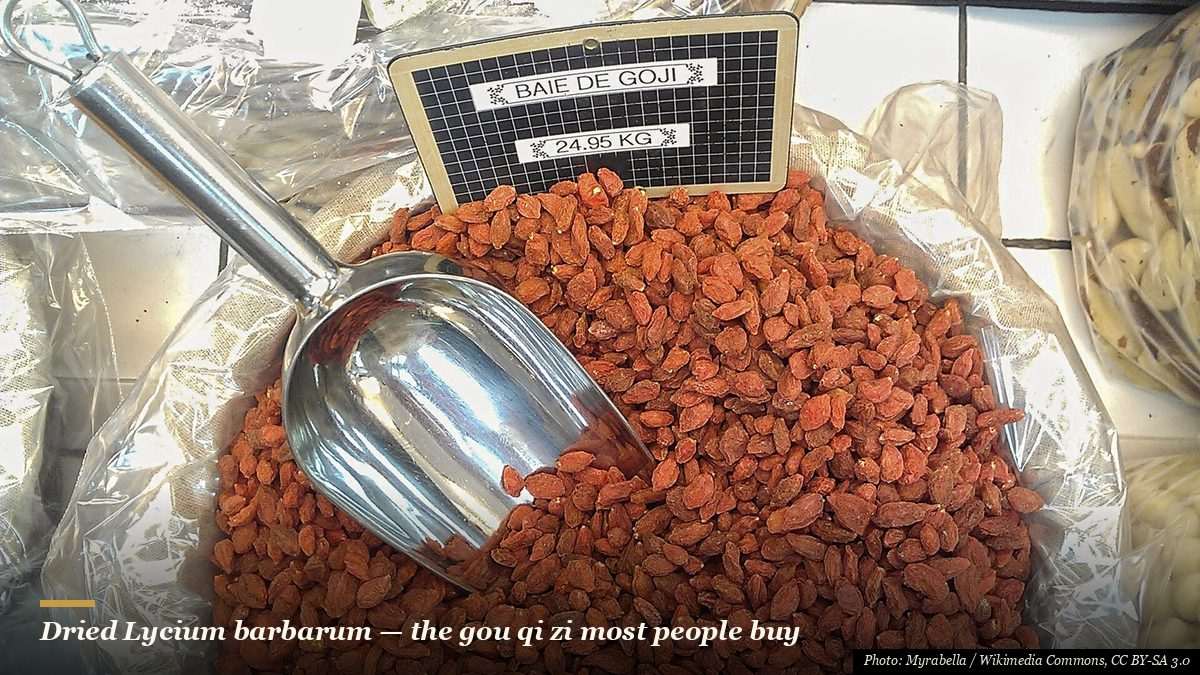
The two species differ in ways that matter to anyone comparing products. L. barbarum berries tend to be larger, meatier, sweeter, and less bitter, with a higher betaine content, while L. chinense fruit is often smaller and more sharply bitter.4 The overwhelming majority of commercially traded goji — on the order of ninety percent — is L. barbarum, and it is this species that Chinese authorities recognize as the official medicinal goji. Interestingly, a careful morphological and metabolomic study of Chinese goji found that while the chemistry cleanly separates the two species, it does not neatly separate berries by growing region — a nuance we’ll return to when we get to the famous Ningxia terroir.4 For a fuller cultural portrait of the plant and its place in daily life, our overview of goji berry in traditional Eastern medicine is a good next stop.
What Is Goji Berry Used For in Traditional Chinese Medicine?
In the vocabulary of Chinese property theory, gou qi zi is classified as sweet (gan) in flavor and neutral (ping) in nature, and it is said to enter the liver, kidney, and lung channels.8 A “neutral” nature is part of why goji is considered so easy to work with: unlike strongly heating or cooling herbs, it is traditionally viewed as a mild, balanced tonic that suits a wide range of constitutions. If the ideas of warm-versus-cool and the organ channels are new to you, our guides to yin-yang theory and the five elements unpack the framework that gives these categories meaning.
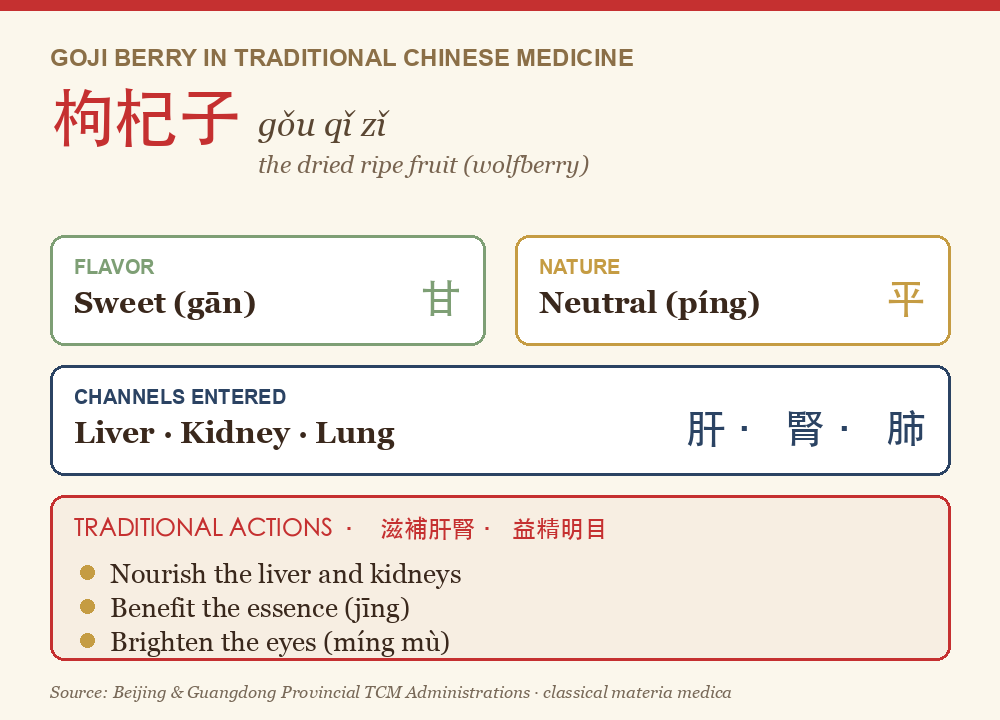
The classical role most associated with goji is captured in a four-character phrase: zi bu gan shen, yi jing ming mu — to enrich and nourish the liver and kidneys, benefit the essence, and brighten the eyes.8 That connection to vision is ancient and durable; goji is the star ingredient in the classic formula Qi Ju Di Huang Wan, which pairs goji with chrysanthemum flower and rehmannia for patterns of liver-and-kidney depletion showing up as dizziness and blurred vision.9 The pairing of goji and chrysanthemum is so classic that the two are often steeped together to this day — you can read more in our chrysanthemum flower tea guide.
One detail Western “superfood” write-ups almost always miss: the goji plant offers traditional practitioners three distinct materia medica, not one. The red fruit (gou qi zi) is the tonic everyone knows; the leaf (gou qi ye) is used to clear heat and calm irritability; and the root bark (di gu pi) is a separate cooling herb entirely, traditionally used to clear “deficiency heat.”9 In traditional formulas goji rarely stands alone; it is combined with companions the way a court is assembled around a ruler, following the logic explored in our pillar on Chinese herbal traditions. For a deeper look at the fruit’s specific traditional applications, see our guide to goji berry’s traditional uses.
Where Does the Best Goji Come From? Ningxia and the Terroir Question
Ask anyone in China where the best goji grows and you will hear one answer: Ningxia. This small autonomous region on the arid Loess Plateau of the upper Yellow River has been the heartland of goji cultivation for centuries, and its reputation is not merely folklore. Ningxia goji is the only goji formally recognized in the Chinese Pharmacopoeia as the official medicinal gou qi zi, and “Ningxia goji” has been protected since 2004 as a geographical-indication product — the same kind of origin protection that governs Champagne or Parmesan.10
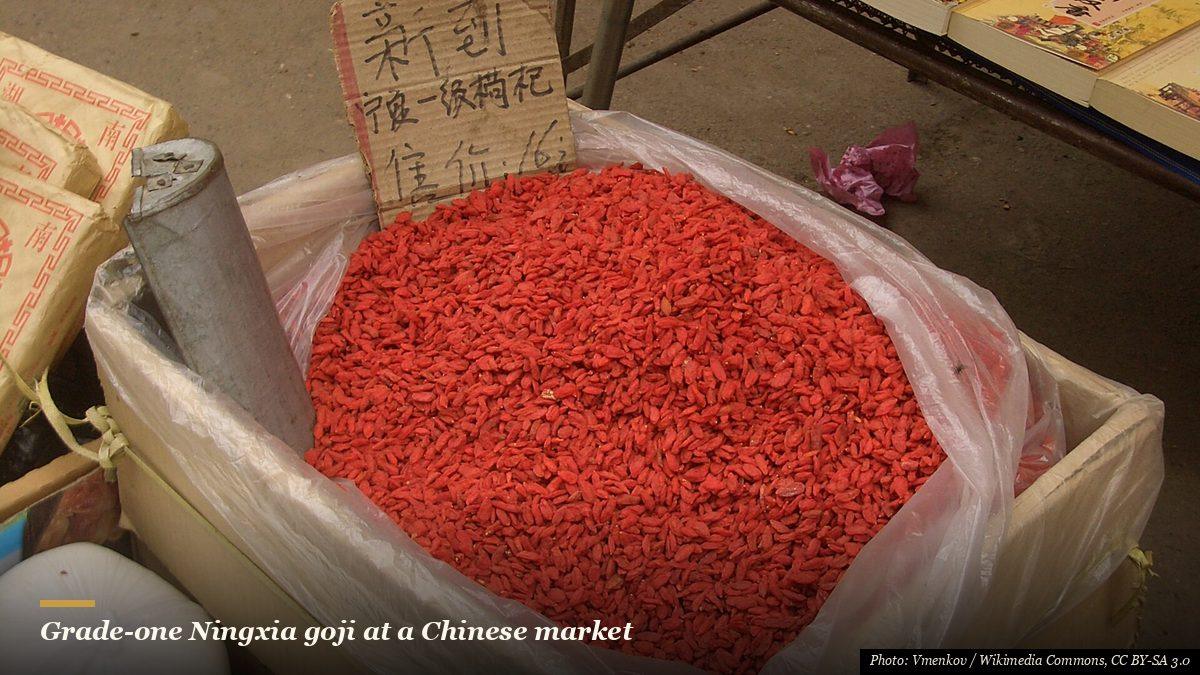
The traditional argument for Ningxia is one of daodi — the idea that a genuine medicinal herb carries the signature of its authentic place of origin. Ningxia’s wide day-to-night temperature swings, intense sunshine, alkaline soils, and mineral-rich Yellow River irrigation are credited with producing berries that are larger, redder, sweeter, and higher in certain markers such as selenium.10 The pharmacopoeial quality standard for Ningxia goji even fixes minimum levels for two signature compounds — goji polysaccharides and betaine — among its nine testing indicators.
Here is where an honest guide has to add a wrinkle. When researchers actually applied metabolomic analysis to goji from different Chinese regions, they could reliably tell the two species apart but could not cleanly rank one growing area as chemically superior to another; their data “do not justify superiority of a specific production area over other areas.”4 In other words, the Ningxia reputation is culturally and historically real and remains a reasonable marker of pedigree and careful cultivation — but the science suggests that species identity and growing practices may matter at least as much as the postcode on the bag. A useful, non-dogmatic way to hold both truths at once.
What’s Actually Inside a Goji Berry?
Goji owes its modern research interest to an unusually dense mix of compounds packed into a small dried fruit. Three groups get the most attention, and it helps to picture them as distinct characters rather than a single “active ingredient.”
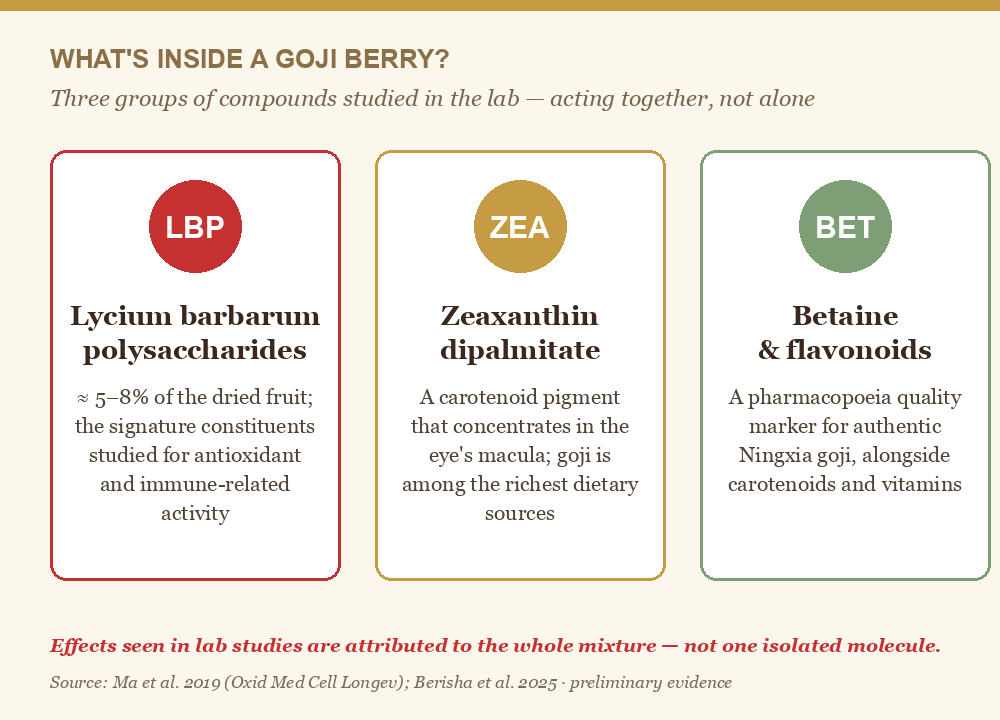
Lycium barbarum polysaccharides (LBPs) are the signature constituents — complex sugar-protein molecules that make up roughly five to eight percent of the dried fruit’s dry matter and are built from a family of simple sugars including arabinose, galactose, glucose, and rhamnose.3 Much of the preclinical research on goji orbits these polysaccharides, which are studied for antioxidant and immune-related activity in laboratory and animal models. One review notes that in the gut, LBPs are partially broken down into smaller sugars and appear to distribute toward immune tissues — an interesting clue, though a long way from proof of benefit in people.5
Zeaxanthin is the second headline compound, and it is the reason goji keeps turning up in eye-health conversations. Goji is one of the richest known dietary sources of zeaxanthin, most of it in the form of zeaxanthin dipalmitate, which can account for a large share of the berry’s total carotenoids.3 Zeaxanthin and its cousin lutein are the pigments that concentrate in the macula of the eye, where they help filter blue light. Notably, the body seems to absorb goji’s zeaxanthin far better when the berries are eaten with a little fat — one reason traditional preparations that simmer goji into soups or steep it alongside milk may be quietly smart.5
Betaine, along with a spread of flavonoids, carotenoids, and vitamins, rounds out the profile. Betaine is prominent enough that, as noted above, it is one of the compounds the Chinese Pharmacopoeia uses to verify authentic Ningxia goji. The broader point that antioxidant researchers stress is that goji’s constituents appear to act together: the protective effects seen in the lab are generally attributed to the whole mixture of polysaccharides, carotenoids, and flavonoids rather than to any single isolated molecule.3
What Does the Research Say About Goji Berry?
This is where enthusiasm needs to meet evidence, because the honest summary is: promising in places, preliminary almost everywhere. Most of what we know about goji comes from cell and animal studies; rigorous human trials remain relatively few and generally small.
The most intriguing human data so far concern the eyes. In a randomized pilot trial, healthy middle-aged adults who ate 28 grams of goji berries five times a week for 90 days showed a significant rise in macular pigment optical density — a measure tied to the eye’s protective pigment layer — while a comparison group taking a matched lutein-and-zeaxanthin supplement did not.1 It is a small study, and the authors are careful to frame it as a starting point rather than a verdict, but it hints that whole goji fruit may deliver its carotenoids in a usefully bioavailable form.
Beyond the eyes, the picture is murkier. Memorial Sloan Kettering Cancer Center’s integrative-medicine review summarizes preclinical signals for immune-modulating and antioxidant activity, some early data on well-being and blood sugar, and then states plainly that “the safety and efficacy of lycium for chronic diseases has not been established.”6 The center also points out that sensational marketing claims — including a notorious false assertion that a cancer center had proven goji juice prevents most breast cancers — have badly outrun the actual science. More broadly, U.S. health authorities caution that studies of Chinese herbal products often suffer from quality and consistency problems, so firm effectiveness claims are rarely warranted.7 The reasonable posture, then, is curiosity without credulity: goji is a nourishing traditional food with some encouraging early research, not a proven remedy.
How Do People Use Goji Berry?
Part of goji’s staying power is how forgiving it is in the kitchen. Because the dried berries are mildly sweet and pleasant on their own, they slot into daily life with almost no fuss. Here are the forms people reach for most.
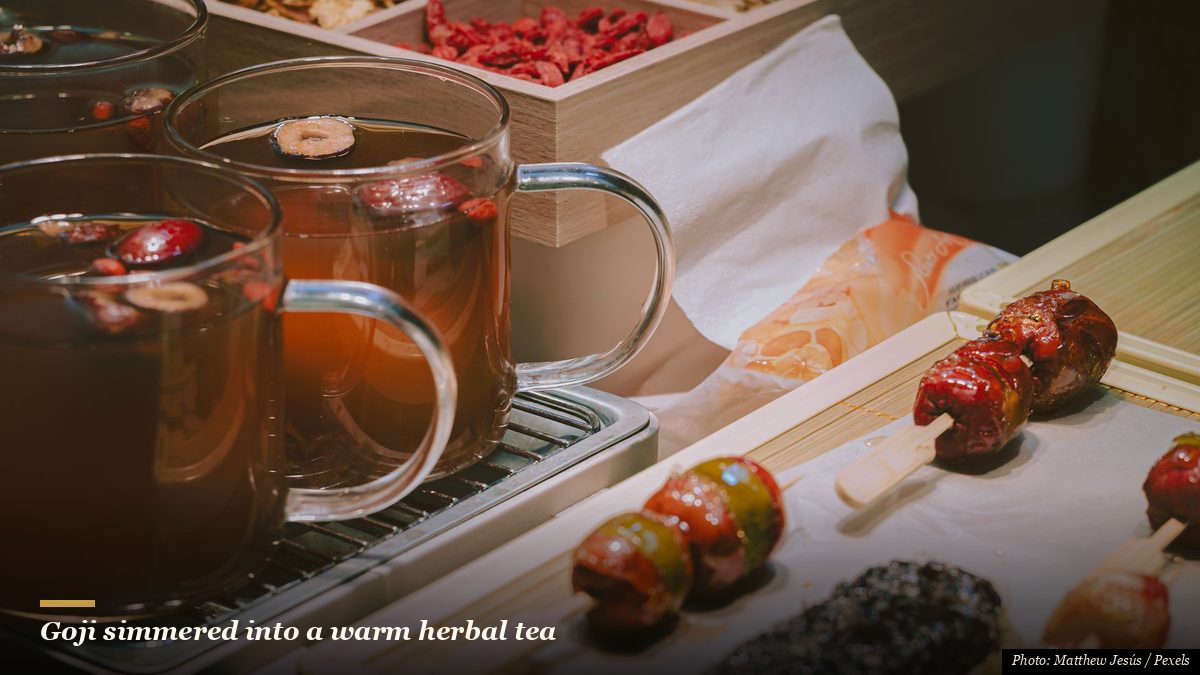
- Eaten dried, by the handful. The simplest use of all — a small scattering of dried goji tossed onto oatmeal, yogurt, trail mix, or salad, or simply chewed as a snack.
- Steeped as tea. A spoonful of dried berries in hot water makes a gentle, faintly sweet infusion, often combined with chrysanthemum or red dates. Our goji berry tea guide walks through ratios and pairings in detail.
- Simmered into congee and soups. Goji is a classic finishing touch in rice porridge and in slow-cooked nourishing soups, where the fat from meat or the richness of the broth may help the berry’s carotenoids absorb. Our traditional goji berry soup recipe shows one time-honored approach.
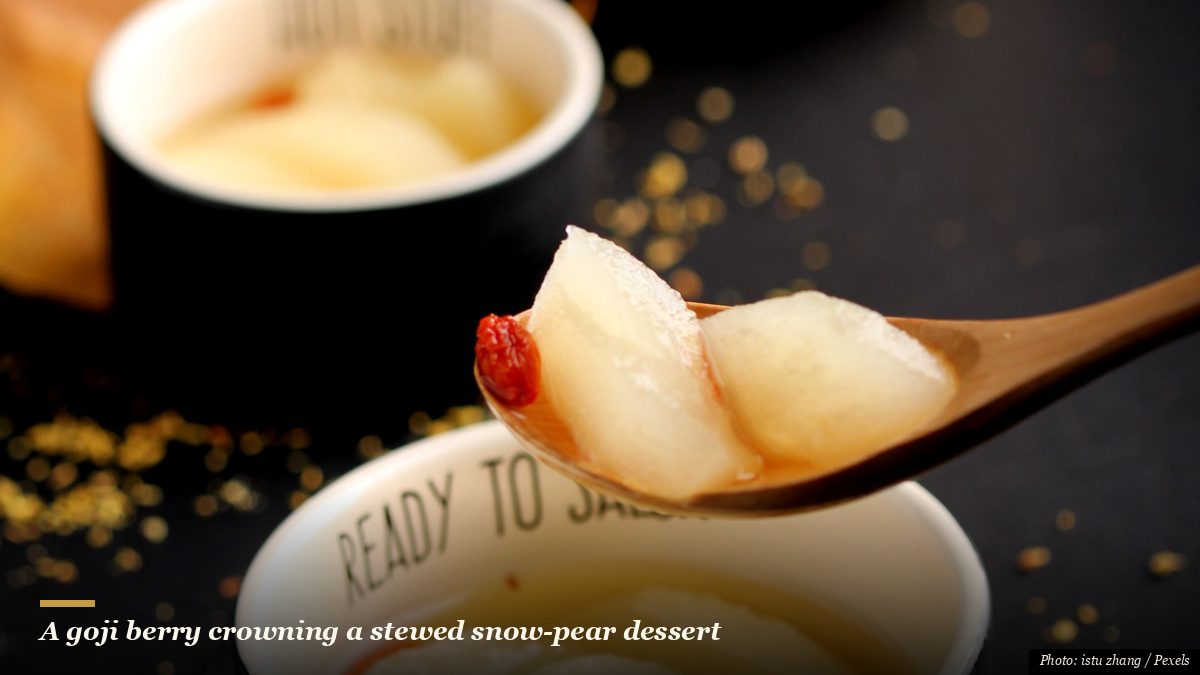
- Cooked into desserts. A few berries brighten a bowl of stewed snow pear or a sweet tong sui, adding color and a subtle sweetness.
- Steeped in wine or spirits. A traditional preparation in which dried goji is infused into rice wine or spirit over weeks — a form worth flagging, since the alcohol carrier is also relevant to the safety notes below.
Because goji is such a staple of unhurried, restorative cooking, it also shows up in the evening-wind-down rituals covered in our guides to bedtime herbal tea traditions and sleep herbs in Asian traditions. It sits alongside other gentle tonic staples such as astragalus and the more potent ginseng in the everyday materia medica of Chinese kitchens; where ginseng is a strong, warming qi tonic reserved for particular moments, goji is the mild, daily companion. Individual responses vary considerably; what works well for one person may not suit another, and any herbal habit is best explored gently and, where relevant, with practitioner guidance.
Important Limitations and Considerations
Goji is widely eaten as an ordinary food, and for most healthy people modest culinary amounts are well tolerated. But “natural” is not the same as “risk-free,” and a few cautions deserve real attention.
- Warfarin and blood thinners. This is the best-documented concern. Several published case reports describe people on stable warfarin whose INR (a clotting measure) jumped dangerously after consuming goji — including a man whose INR rose from 2.46 to 3.84 with visible bleeding after drinking just 20 ml of goji wine, resolving once he stopped.2 If you take warfarin or another anticoagulant, treat goji as something to discuss with your doctor before using.
- Medication metabolism. Goji may affect enzymes (including CYP3A4, CYP2C9, and CYP2C19) that process many common drugs, which is part of the mechanism behind the warfarin interaction and a reason for caution with other prescriptions.6
- Diabetes and blood pressure. Goji has been studied for blood-sugar effects and is traditionally sweet; those taking glucose-lowering or blood-pressure medication should monitor carefully and seek advice, and diabetics should be mindful of the sugar content of goji products.9
- Pregnancy and breastfeeding. Goji has not been well studied in pregnancy, and some traditional sources advise caution. If you are pregnant or nursing, check with your provider before using it beyond ordinary food amounts.
- Allergy. Allergic reactions have been reported, particularly in people sensitive to lipid transfer proteins found in some fruits; introduce goji cautiously if you have food allergies.6
- Digestion and constitution. Traditional sources note that goji is not for everyone all the time — those with weak digestion, active colds or fevers, or diarrhea are advised to go easy on it.8
- Quality and purity. As with any imported herbal product, quality varies; buy from reputable suppliers, ideally with third-party testing, since contamination and adulteration have been documented across the herbal sector.7
Individual experiences vary considerably, and the safest way to add any new herb to your routine is slowly, in food-like amounts, and alongside your regular healthcare.
Frequently Asked Questions
Can I eat goji berries every day?
Many people enjoy a small daily handful of dried goji or a cup of goji tea as part of an ordinary diet, and traditional practice favors modest, consistent use over large occasional doses. That said, individual responses vary, and anyone on blood-thinning medication, with diabetes, or who is pregnant should check with a healthcare practitioner before making goji a daily habit.
Does goji berry interact with any medications?
Yes. The clearest concern is with warfarin and other blood thinners, where documented case reports describe raised bleeding risk. Goji may also influence liver enzymes that metabolize many drugs, and it can be relevant for people on diabetes or blood-pressure medication. If you take any prescription medicine, talk to your doctor or pharmacist before adding goji.
What is the difference between goji berries and wolfberries?
They are the same fruit. “Goji berry” and “wolfberry” are two English names for the dried fruit of Lycium barbarum (and its close relative L. chinense), known in Chinese as gou qi zi. “Goji” is the more recent, marketing-friendly name popularized in the West; “wolfberry” is the older English term.
Is Ningxia goji really better than other kinds?
Ningxia goji has the strongest pedigree: it is the only goji recognized in the Chinese Pharmacopoeia and carries geographical-indication protection, and its terroir is genuinely well suited to the crop. However, metabolomic research has not been able to confirm that any single region produces chemically superior berries, suggesting that species and cultivation quality matter alongside origin. Ningxia is a reasonable mark of quality, not a guarantee of superiority.
What do goji berries taste like?
Dried goji berries are mildly sweet with a subtle tang and an earthy, faintly tomato-like note — unsurprising given they are botanical relatives of the tomato. Their texture is chewy, a little like a soft raisin. In tea they release a gentle sweetness into the water.
Are goji berries good for your eyes?
Goji is one of the richest dietary sources of zeaxanthin, a pigment that concentrates in the eye’s macula, and a small human trial found that eating whole goji berries raised macular pigment density. This is encouraging but preliminary; goji is best thought of as a nourishing food that supports a carotenoid-rich diet rather than as a treatment for any eye condition.
Can I use goji berries during pregnancy?
Goji has not been well studied in pregnancy, and some traditional sources counsel caution. Ordinary culinary amounts are generally regarded as food, but concentrated products or medicinal doses are a different matter. If you are pregnant or breastfeeding, consult your provider before using goji beyond a normal dietary level.
How should I store dried goji berries?
Keep dried goji in an airtight container away from heat, light, and moisture — a cool, dark cupboard is ideal, and refrigeration extends freshness in humid climates. Good berries stay plump and bright red; if they darken, clump, or smell off, it is time to replace them.
A Note on Tracking Your Wellness Journey
One thing traditional Chinese wellness and modern self-care agree on is that patterns matter more than single moments. A practitioner reads how your sleep, energy, digestion, and eyes feel across weeks and seasons rather than on any one day. You can bring the same patient attention to your own routine. If you begin sipping goji tea in the evenings or adding a spoonful to your morning bowl, jotting down how you actually feel over the following weeks turns a vague impression into something useful — the kind of gentle, long-view self-observation the Health Diary approach is built around, and far more informative to share with a practitioner than a hazy memory.
A Soft Closing Note
Goji berries are best appreciated not as a miracle in a bag but as one small, well-traveled thread in a two-thousand-year-old fabric of paying attention — to plants, to the eyes, to the seasons, and to the particular person doing the eating. Whether you arrived here curious about a single cup of tea or about the whole tradition behind it, the branches of this collection are yours to wander: the practical goji tea guide and soup recipe, the fuller traditional-uses guide, the classic chrysanthemum pairing, or the founding ideas of yin and yang and the five elements. Explore slowly, stay curious, and let a qualified practitioner and your own regular healthcare guide any step you take.
About This Article
Written by: Health Diary Editorial Team — researchers specializing in Asian wellness traditions, herbal history, and food culture.
Editorial review: This article has been reviewed by the Health Diary editorial team for clarity, structure, and adherence to our sourcing standards. Key claims were cross-checked against NCCIH, NIH PubMed / PMC peer-reviewed literature, and Memorial Sloan Kettering’s integrative-medicine database, with native-language (中文) verification of classical provenance and the Ningxia geographical-indication standard through the Beijing and Guangdong provincial TCM administrations and Guangming Daily. It is not a clinical review and should not replace consultation with a licensed healthcare practitioner.
Reviewed on: August 3, 2026.
Editorial process: We cite peer-reviewed and government sources where possible. When a clinical reviewer is added to this article, attribution will appear here with verifiable credentials.
References
- Li X, Holt RR, Keen CL, Morse LS, Yiu G, Hackman RM. “Goji Berry Intake Increases Macular Pigment Optical Density in Healthy Adults: A Randomized Pilot Trial.” Nutrients. 2021;13(12):4409. https://pmc.ncbi.nlm.nih.gov/articles/PMC8708314/
- Zhang J, Tian L, Xie B. “Bleeding due to a probable interaction between warfarin and Gouqizi (Lycium barbarum L.).” Toxicology Reports. 2015;2:1209–1212. https://pmc.ncbi.nlm.nih.gov/articles/PMC5598317/
- Ma ZF, Zhang H, Teh SS, et al. “Goji Berries as a Potential Natural Antioxidant Medicine: An Insight into Their Molecular Mechanisms of Action.” Oxidative Medicine and Cellular Longevity. 2019;2019:2437397. https://pubmed.ncbi.nlm.nih.gov/30728882/
- Yao R, Heinrich M, Zou Y, et al. “Quality Variation of Goji (Fruits of Lycium spp.) in China: A Comparative Morphological and Metabolomic Analysis.” Frontiers in Pharmacology. 2018;9:151. https://pmc.ncbi.nlm.nih.gov/articles/PMC5834758/
- Berisha A, Alexa EA, Kelleher R, Zhang T. “From botany to bedside: a review of the health benefits of Lycium barbarum as a functional food.” Exploration of Foods and Foodomics. 2025. https://www.explorationpub.com/Journals/eff/Article/101070
- Memorial Sloan Kettering Cancer Center. “Lycium (About Herbs).” Integrative Medicine. https://www.mskcc.org/cancer-care/integrative-medicine/herbs/lycium
- National Center for Complementary and Integrative Health (NCCIH). “Traditional Chinese Medicine: What You Need To Know.” 2024. https://www.nccih.nih.gov/health/traditional-chinese-medicine-what-you-need-to-know
- 北京市中医管理局 (Beijing Municipal Administration of Traditional Chinese Medicine). “药食同源 — 枯桶 (Medicine-food homology: goji).” https://zyj.beijing.gov.cn/ylfw/ysbj/202012/t20201203_2156384.html
- 广东省中医药局 (Guangdong Provincial Administration of Traditional Chinese Medicine). “枯桶溈身都是宝,这样用效更好 (Every part of goji is a treasure).” 2022. http://szyyj.gd.gov.cn/zyyfw/ysbj/content/post_3755328.html
- 光明日报 (Guangming Daily). “‘红’了千年的宁夏枯桶 (Ningxia goji, red for a thousand years) — National Geographical Indication Product series.” 2022-12-30. https://epaper.gmw.cn/gmrb/html/2022-12/30/nw.D110000gmrb_20221230_8-01.htm


