Medical Disclaimer: This content is for educational and informational purposes only and is not medical advice. It is not intended to diagnose, treat, cure, or prevent any disease. Always consult a licensed healthcare practitioner before making changes to your diet. Statements regarding traditional tea use have not been evaluated by the FDA.
Affiliate Disclosure: This article may contain affiliate links. We may earn a commission if you purchase through these links, at no additional cost to you. We only recommend products we believe align with our editorial standards.
Few teas are as instantly recognisable as jasmine — that sweet, heady floral aroma rising from the cup is one of the signature scents of Chinese tea culture. But jasmine tea is not simply flavoured tea; at its best it is a patiently scented tea, made by layering real jasmine blossoms with tea leaves over many careful rounds. This guide explains what jasmine tea really is, how it is made, its remarkable heritage, and how to brew it — part of our wider guide to Asian herbal teas.
What Is Jasmine Tea?
Jasmine tea (茉莉花茶) is a scented tea — a finished tea, most often green tea, that has absorbed the fragrance of jasmine (Jasminum sambac) blossoms. The tea itself is true tea from Camellia sinensis; the jasmine lends only its perfume. In the traditional method, the flowers are layered with the tea and then removed, so a fine jasmine tea carries the aroma without the petals (Baidu Baike, jasmine tea).
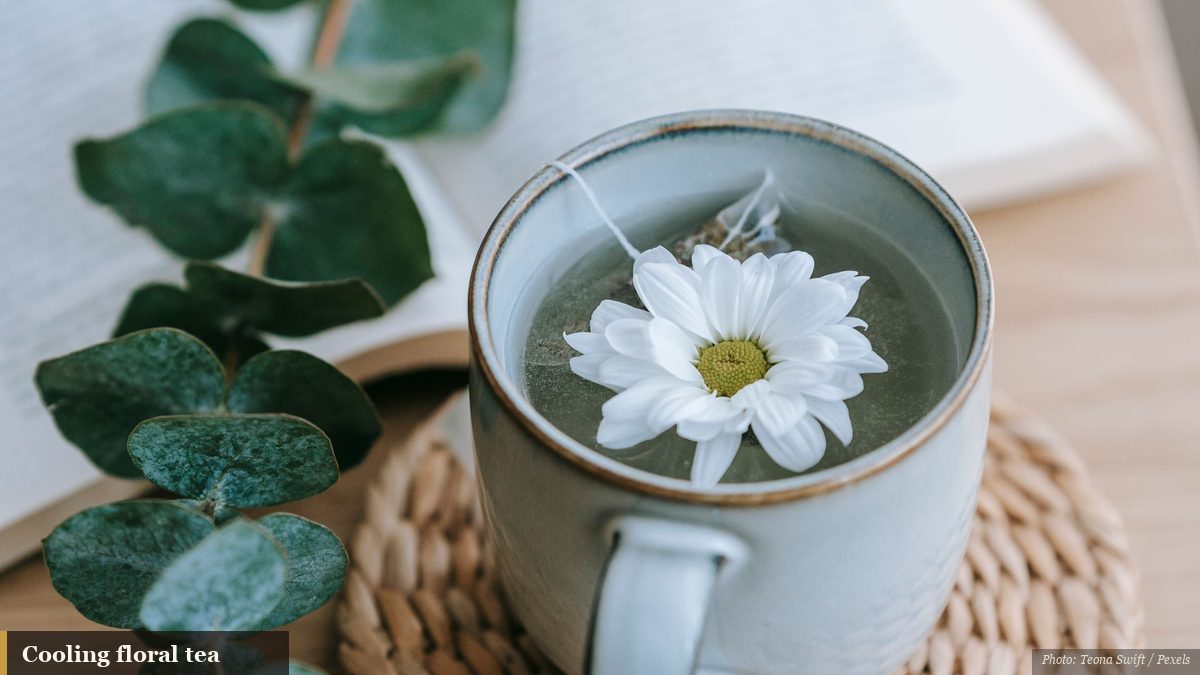
Because the base is usually green tea, jasmine tea shares that fresh, grassy body — softened and lifted by the sweet floral top note. Some premium versions use white or lightly oxidised bases, and the most prized forms are hand-rolled into "jasmine pearls." If you enjoy the calm ritual of a fragrant cup, jasmine tea sits beautifully alongside our guides to relaxation teas and tea culture.
How Is Jasmine Tea Made?
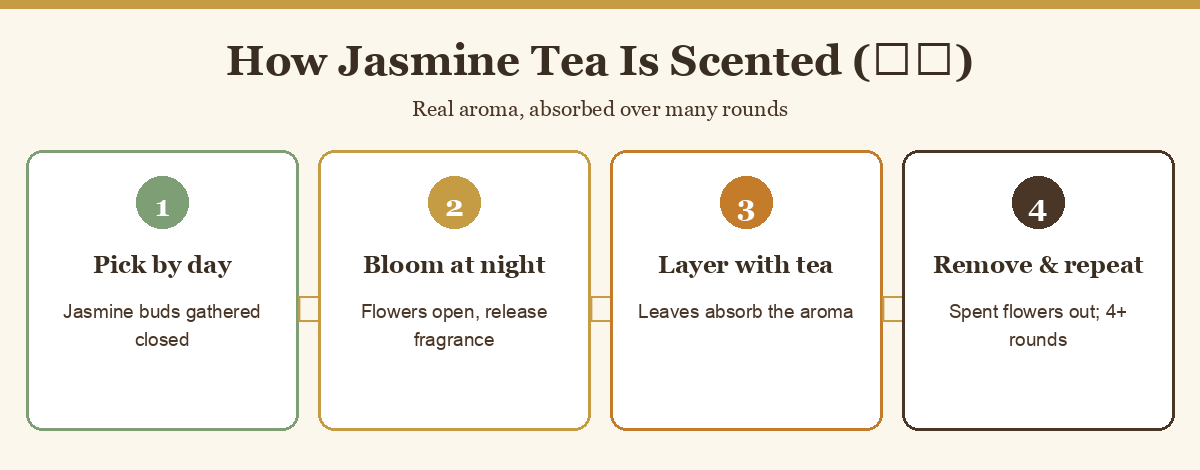
The traditional scenting process, called yìn zhì (窨制), is one of the most labour-intensive in all of tea. Jasmine flowers are picked during the day while still closed, then, as they begin to open and release their fragrance at night, they are layered with the finished tea so the leaves can drink in the aroma. The spent flowers are removed, and the process is repeated — for fine teas, four or more rounds — with a final touch of fresh blossoms (Fuzhou jasmine scenting technique).
This is not mere mixing: the aroma is physically absorbed into the leaf. A 2023 chemical study of the scenting process found that total aroma compounds rose roughly fortyfold across the rounds, with the key floral compound linalool increasing dramatically — proof that real scenting transforms the tea rather than just perfuming it (Zhang et al., 2023). Cheaper products may simply be sprayed with flavouring, which is why a genuinely scented tea tastes so much rounder.
A Tea with Deep Heritage
Jasmine tea is centuries old. The city of Fuzhou in Fujian is regarded as its historic home, with roughly a thousand years of jasmine-tea scenting behind it; the process was already being documented in the Song dynasty. Fuzhou's "jasmine and tea culture system" is so significant that it was recognised by the United Nations' FAO as a Globally Important Agricultural Heritage System, and the scenting craft is inscribed on China's national intangible cultural heritage list (Government of Fujian).
Today the story has a second chapter: Hengzhou (Hengxian) in Guangxi has become the world's largest jasmine-growing region, producing a majority of the world's jasmine flowers. So jasmine tea neatly bridges old and new — Fuzhou holding the heritage, Guangxi supplying the modern harvest. It belongs firmly within the broader story of Chinese tea tradition.
Does Jasmine Tea Have Caffeine?
Yes — the caffeine comes from the green-tea base, not the jasmine flowers, which contribute only aroma. Because it is usually built on green tea, jasmine tea carries a moderate amount of caffeine, along with the tea plant's calming amino acid L-theanine. If you are sensitive to caffeine or drinking late in the day, keep that in mind, or seek out a naturally caffeine-free tisane from our cooling herbal teas guide instead. As with all teas, brewing time and temperature shape how much caffeine ends up in your cup.
What Does Modern Research Say?
Two threads of research touch jasmine tea, and both deserve a measured reading. First, the base green tea contains polyphenols such as EGCG and the amino acid L-theanine; a systematic review suggests L-theanine may modestly help with stress and anxiety, though the doses studied were far higher than a single cup provides (Williams et al., 2020). Health authorities note that green tea's broader benefits are mostly unproven or inconclusive in humans (NCCIH).
Second — and more distinctive to jasmine — is the aroma itself. A small human study found that simply smelling jasmine tea's scent had a calming, sedative effect, lowering heart rate and shifting the nervous system toward its relaxed state, with linalool reproducing the effect (Kuroda et al., 2005). It is worth being precise here: that study was about inhaling the fragrance, not drinking the tea — so the calming association is really about the aroma and the ritual as much as anything you swallow. Individual responses vary considerably.
How Do You Brew Jasmine Tea?
Because the base is usually green tea, jasmine tea prefers cooler water — around 75–85°C rather than a rolling boil, which can turn a green base bitter and scald the delicate fragrance. Use about a teaspoon of leaf (or a small spoon of pearls) per cup, steep for one to three minutes, and taste as you go. Good jasmine pearls unfurl slowly and can be re-steeped several times, releasing more aroma with each infusion — a small, fragrant ritual explored further in our tea rituals and daily tea guides.
Safety and Considerations
- Caffeine. Jasmine tea contains caffeine from its green-tea base; moderate your intake in the evening and during pregnancy, when health authorities advise limiting caffeine (NCCIH).
- Medication interactions. Green tea can interact with some medicines, including nadolol and atorvastatin; check with a pharmacist if you take prescription drugs (MSK).
- Aroma is not a therapy. The calming-scent research is small and preliminary; enjoy jasmine tea for its pleasure, not as a treatment for stress or sleep.
- Beverage, not extract. These notes concern brewed tea; concentrated green-tea extracts are far stronger.
- Individual responses vary considerably.
Frequently Asked Questions
Does jasmine tea have caffeine?
Yes, but it comes from the green-tea base, not the jasmine flowers, which add only aroma. The exact amount depends on the base tea and how you brew it (Baidu Baike).
Is jasmine tea good for relaxation or sleep?
The aroma of jasmine tea has shown a small calming effect in one human study, and L-theanine in the base tea may modestly ease stress at higher doses. But jasmine tea also contains caffeine, so it is not a sleep aid — enjoy it for its soothing ritual rather than as a remedy (Kuroda et al., 2005).
How is jasmine tea made — are there real flowers?
Traditionally, yes. Real Jasminum sambac blossoms are layered with tea over multiple night-time scenting rounds so the leaves absorb the fragrance, then the flowers are removed. Cheaper products may use added flavouring instead (Zhang et al., 2023).
What does jasmine tea taste like?
A fresh, slightly grassy green-tea body lifted by a sweet, heady floral aroma — the signature note is linalool. A well-scented tea tastes rounded and fragrant rather than perfumed or soapy.
How should I brew jasmine tea?
Use cooler water (around 75–85°C), a teaspoon of leaf or pearls per cup, and a short one-to-three-minute steep. Avoid boiling water, which can make the green base bitter and burn off the delicate scent.
A Note on Enjoying Jasmine Tea
Jasmine tea is, above all, a sensory pleasure — the moment you lift the cup and breathe in is part of the experience. Seek out a genuinely scented tea rather than a sprayed one, brew it gently, and take a breath before the first sip. Our Asian herbal teas guide, oolong guide, and pu-erh guide are good places to continue exploring Chinese tea.
About This Article
Written by: Health Diary Editorial Team — writers and researchers focused on making traditional Asian wellness knowledge clear, accurate, and culturally grounded.
Editorial review: This article has been reviewed by the Health Diary editorial team for clarity, structure, and adherence to our sourcing standards. Key claims were cross-checked against peer-reviewed research, NCCIH, and native-language sources where applicable. It is not a clinical review and should not replace consultation with a licensed healthcare practitioner.
Reviewed on: August 4, 2026.
Editorial process: We cite peer-reviewed and government sources where possible, and we carefully distinguish the effects of smelling jasmine aroma from drinking the tea, rather than blurring the two.
References
- Kuroda K, et al. Sedative effects of the jasmine tea odor and (R)-(−)-linalool on autonomic nerve activity and mood. Eur J Appl Physiol. 2005. https://pubmed.ncbi.nlm.nih.gov/15976995/
- Zhang C, et al. Volatilomics Analysis of Jasmine Tea during Multiple Rounds of Scenting. Foods. 2023. https://pmc.ncbi.nlm.nih.gov/articles/PMC9956320/
- Williams JL, et al. The Effects of Green Tea Amino Acid L-Theanine on Stress and Anxiety: a Systematic Review. Plant Foods Hum Nutr. 2020. https://link.springer.com/article/10.1007/s11130-019-00771-5
- NCCIH. Green Tea: Usefulness and Safety. https://www.nccih.nih.gov/health/green-tea
- Memorial Sloan Kettering. About Herbs — Green Tea. https://www.mskcc.org/cancer-care/integrative-medicine/herbs/green-tea
- Government of Fujian. National ICH: Fuzhou jasmine tea scenting technique. https://www.fujian.gov.cn/english/cultureandtravel/cultureandarts/202504/t20250403_6796773.htm
- 百度百科 — 茉莉花茶 (jasmine tea). https://baike.baidu.com/item/茉莉花茶/1173
- 百度百科 — 福州茉莉花茶窨制工艺 (Fuzhou scenting technique). https://baike.baidu.com/item/花茶制作技艺(福州茉莉花茶窨制工艺)/22839561
- 福建省农业农村厅 — 福州茉莉花与茶文化系统 (FAO GIAHS). https://nynct.fujian.gov.cn/ztzl/fsfsfnyp/202404/t20240410_6426758.htm
- 横州茉莉花产业 (Hengzhou jasmine, Guangxi). http://nynct.gxzf.gov.cn/xwdt/gxlb/nn/t21247516.shtml