
Complete Guide to Hojicha: Japan's Roasted Green Tea
A complete pillar guide to hojicha (ほうじ茶), Japan's roasted green tea: its Kyoto origins, roasting chemistry, types, low caffeine, and how people drink it.
Medical Disclaimer: This content is for educational and informational purposes only and is not medical advice. It reflects traditional Japanese cultural practices and general wellness traditions and is not intended to diagnose, treat, cure, or prevent any disease. Always consult a licensed healthcare practitioner before starting any new herbal practice, dietary change, or supplement. Statements regarding traditional tea use have not been evaluated by the FDA.
Affiliate Disclosure: This article may contain affiliate links. We may earn a commission if you purchase through these links, at no additional cost to you. We only recommend products we believe align with our editorial standards.
Most Japanese green teas are prized for staying green — bright, grassy, vegetal, and full of the fresh compounds that steaming locks in. Hojicha (ほうじ茶, also written 焙じ茶) is the deliberate exception. It is green tea that has been taken to a roasting drum and toasted until the leaves turn a warm reddish-brown, the grassy edge falls away, and the cup fills with an aroma closer to toasted rice, caramel, and woodsmoke than to fresh leaves. The result is unmistakably Japanese and yet unlike almost anything else in the Japanese tea cabinet: amber in the cup, gentle on the stomach, low in caffeine, and beloved as the tea you reach for in the evening, serve to children, or drink by the potful alongside a meal.
This guide is a hub for the whole subject. Hojicha is not really a single leaf but a process — a way of roasting that can be applied to ordinary sencha, to twig tea, or to coarse late-harvest leaves — so understanding it means understanding what roasting does to tea chemistry, where the tradition came from, how the many styles differ, and who tends to enjoy it. We will move through each of these in turn, keeping the science honest and preliminary where it should be, and linking down to our deeper companion articles so you can follow whichever thread pulls at you. If you want the full origin story and roasting chemistry in detail, our profile of hojicha in traditional Eastern wellness goes further than we can here; for a side-by-side breakdown against unroasted teas, see our hojicha vs green tea comparison.
What Is Hojicha, Exactly?
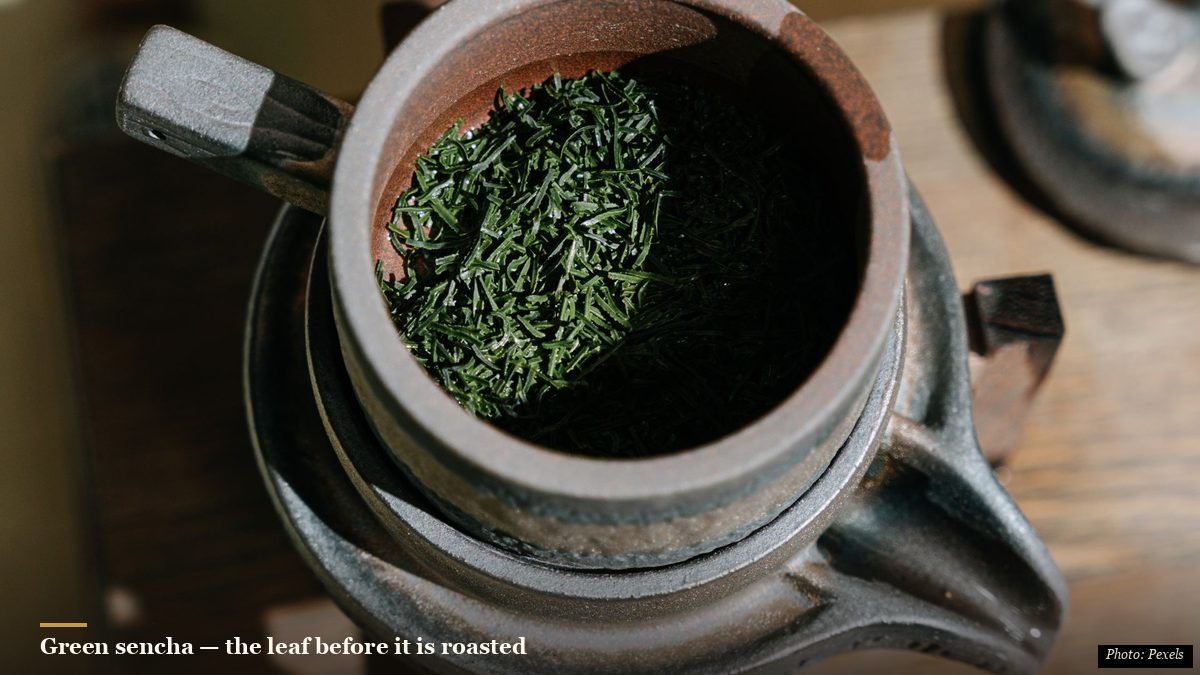
Hojicha is roasted Japanese green tea. The name comes from the verb hojiru (焙じる), "to roast over heat," and that single act is what defines the category. Everything else — the amber colour, the toasty perfume, the mild flavour, the low caffeine — follows from putting already-finished green tea into a hot roaster and driving off its fresh, grassy character. Because roasting is a finishing step rather than a growing or picking method, hojicha starts life as some other tea entirely. Most commonly the base is bancha, the coarser, later-harvest leaf, but higher grades are roasted from sencha or from the stems and twigs that make up kukicha.
In the cup, the contrast with the rest of the Japanese line-up is dramatic. Where matcha is intense, bittersweet, and vivid green, and where sencha is fresh and astringent, hojicha is clear amber-brown, rounded, almost sweet, and remarkably low in bitterness. Ito En, one of Japan's largest tea companies, markets its hojicha precisely for this "sweet, roasty" aroma and its low astringency (Ito En product information). It is a tea you can drink late, drink a lot of, and drink without the pucker that stronger green teas can bring. Think of this article as the trunk of a tree: the sections below branch out into origin, chemistry, types, caffeine, research, and ritual, each linking to a fuller guide.
Where Did Hojicha Come From?
Hojicha is a surprisingly young tradition. The roasting method as we know it is generally credited to Kyoto tea merchants in the 1920s, who were looking for a way to make use of lower-grade leaves, stems, and the leftovers that piled up at the bottom of the harvest (Japanese-language reference on hojicha). Rather than discard them — an offence to the deep-rooted Japanese sensibility of mottainai, the regret of waste — they roasted them over strong heat. The high temperature masked any staleness, transformed a humble raw material into something fragrant, and produced a mellow, everyday brew that was cheap enough for daily drinking.
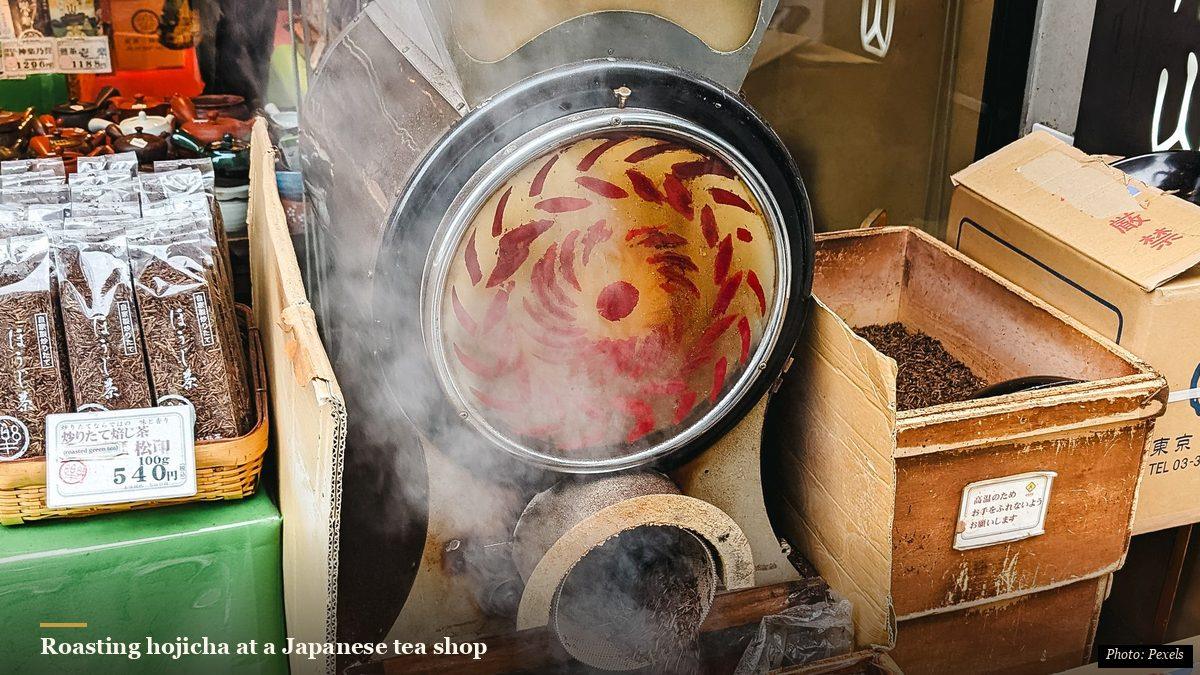
For decades hojicha carried exactly that identity: an affordable, common tea, poured at meals, in homes, and in the small restaurants of Kyoto, where the toasty aroma drifting from a roaster was itself an advertisement. In recent years it has enjoyed a striking revival — Ito En has estimated that the hojicha market grew roughly sixteen-fold between 2005 and 2016 — as cafés, pastry chefs, and a caffeine-wary generation rediscovered its warmth. The full arc of that story, from thrift to modern trend, is the subject of our dedicated hojicha origin and tradition guide.
What Does Roasting Actually Do to the Tea?
The heart of hojicha is a chemical transformation, and it is worth understanding because almost every distinctive quality of the tea traces back to it. When finished green tea is roasted — traditionally over charcoal, now usually in rotating drums, with reported optimal temperatures in the region of 160–170 °C — three things happen at once.
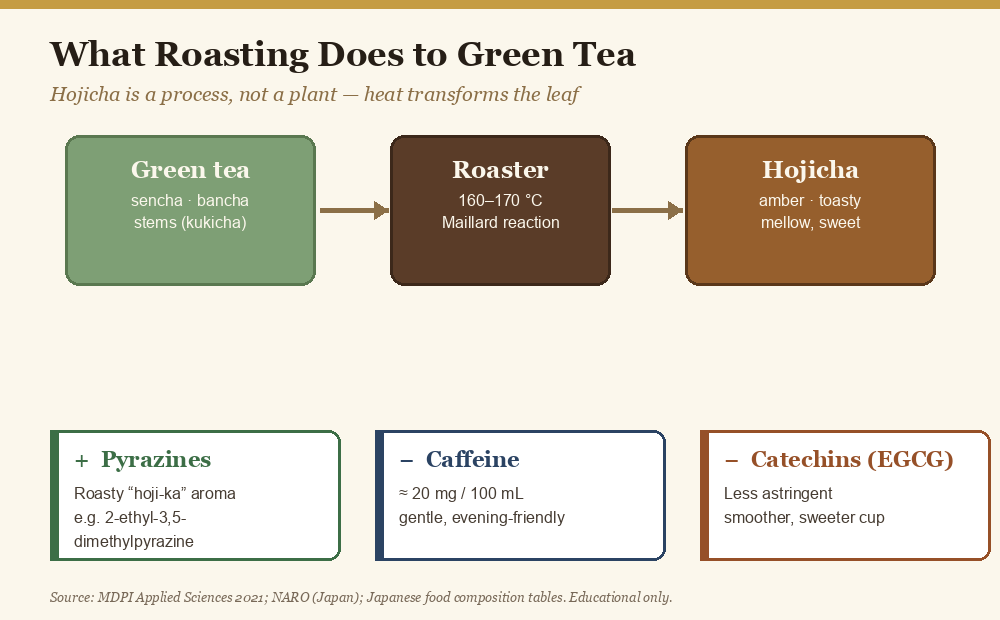
First, the roast creates new aroma compounds. The toasty "hoji-ka" fragrance is built largely from pyrazines, a family of molecules produced by the Maillard reaction between the tea's amino acids and sugars under heat. A 2021 analysis using headspace GC-MS found that roasting significantly raised pyrazine content and that these pyrazines are among the most contributory odorants of roasted green tea's flavour; because they are highly volatile, they reach your nose before the liquid even touches your tongue (Applied Sciences, 2021). Japanese government research at NARO, using gas chromatography-olfactometry, pinned down specific culprits — including 2-ethyl-3,5-dimethylpyrazine for the roasty note, alongside furaneol for sweetness — and mapped roast intensity to leaf-surface temperatures of roughly 100 °C (light), 115 °C (medium), and 130 °C (heavy) (NARO, Vegetable & Tea Science Division).
Second, roasting reduces the sharp compounds that define fresh green tea. The catechins — above all epigallocatechin gallate (EGCG), the astringent, slightly bitter polyphenol that dominates sencha — are partly broken down by heat. Laboratory work on EGCG under thermal stress shows it declines steadily at roasting-range temperatures, first epimerising to its relative gallocatechin gallate (GCG) and then degrading further (Journal of Food Engineering, 2019). This is why hojicha tastes so smooth and un-bitter: the roaster has quietly removed much of what makes green tea grip the tongue. Third, and closely related, the roast lowers caffeine, which we look at in its own section below.
The chemistry of roasting is genuinely fascinating, and we treat it at greater length — panel by panel — in our detailed hojicha profile. The one-line summary: roasting trades away freshness and stimulation for warmth, sweetness, and calm.
What Are the Different Types of Hojicha?
Because hojicha is defined by roasting rather than by a single leaf, the category contains a whole family of styles. The main axes of variation are the base material and the depth of the roast.
By base material, you will most often meet three kinds. Leaf hojicha, roasted from bancha or sencha leaves, is the classic version — full-bodied and clearly "tea." Twig or stem hojicha is roasted from the stalks and stems used in kukicha; it is lighter, sweeter, and lower in caffeine still, and in the Kanazawa region a celebrated roasted stem tea is known as kaga-bocha. There is even a premium end where tender first-flush leaves are roasted to keep a hint of their finer character. A close cousin worth knowing is genmaicha, green tea blended with roasted brown rice, which shares hojicha's toasty comfort through a different route.
By roast depth, a light roast keeps more of the tea's body and a gentle amber colour, while a dark roast pushes toward coffee-like depth, smoke, and a near-mahogany brew. Finally, hojicha now also comes as a stone-milled or finely ground powder, used the way matcha powder is — whisked into lattes, folded into ice cream, and baked into pastries, where its caramel notes shine without matcha's cost or bitterness. Whichever style you meet, the underlying identity is the same roasted-tea character; the differences are ones of degree. For how these styles stack up against unroasted Japanese teas, our hojicha vs green tea guide lays them side by side.
How Much Caffeine Is in Hojicha?
Low caffeine is the single quality most people associate with hojicha, and for once the reputation is well founded. Two things lower it. The base is often bancha or twig tea, which start with less caffeine than young top leaves; and the roasting heat itself drives some caffeine off. Japan's official food composition tables list a standard hojicha infusion at roughly 20 mg of caffeine per 100 mL, and Ito En's bottled hojicha comes in around 13 mg per 100 mL (Ito En). For comparison, the Cleveland Clinic puts an ordinary cup of green tea near 30 mg per 8-ounce serving, itself less than a third of a coffee (Cleveland Clinic).
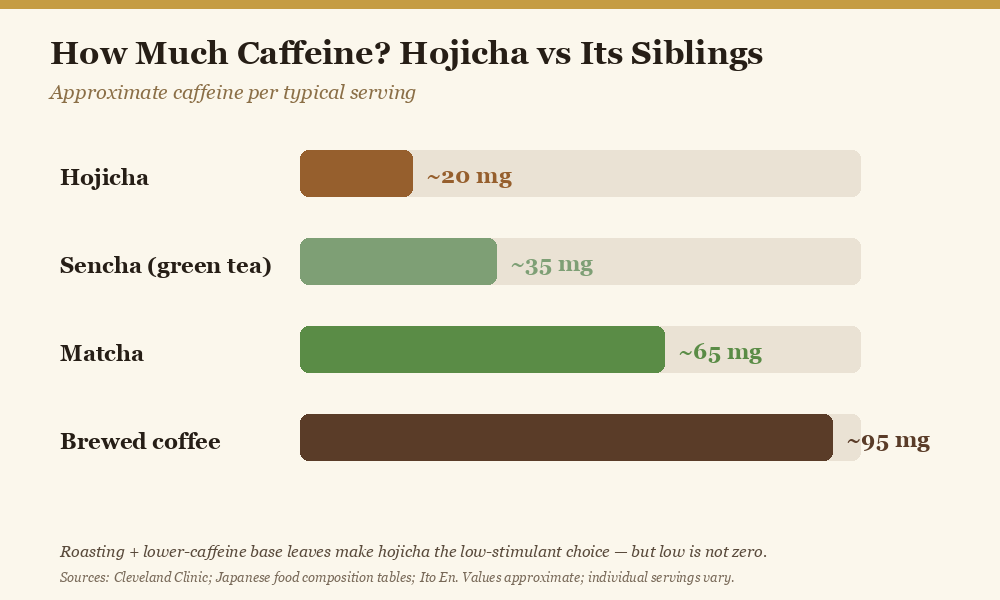
Set against its Japanese siblings, the ranking is clear: hojicha sits at the bottom, sencha in the middle, and matcha — where you consume the whole powdered leaf — near the top, with brewed coffee higher still. That gap is exactly why hojicha became the household tea to drink after dinner, to give to children, and to offer anyone who finds stronger teas or coffee too stimulating. It is worth a small honesty, though: "low caffeine" is not "no caffeine," and individual sensitivity varies a great deal. If you are highly caffeine-reactive, even a modest cup late at night may be felt. We compare the caffeine of the roasted and unroasted teas more fully in our hojicha vs green tea guide and, on the higher-caffeine end, in our complete guide to matcha.
What Does Modern Research Suggest About Hojicha?
It is important to be measured here. Hojicha has been studied far less than matcha or sencha, and most of what exists looks at chemistry and flavour rather than health outcomes in people. What follows points to plausible ideas, not proven benefits, and none of it should be read as a reason to treat any condition.
The most interesting recent findings concern what happens to the tea's compounds. Because roasting breaks down a portion of the catechins, hojicha contains less EGCG than unroasted green tea — but the story is not simply "roasting destroys the antioxidants." A 2025 digestion study found that roasting alters catechin composition rather than erasing it: some catechins oligomerise into new polyphenols, EC and ECG prove more heat-stable than EGCG, and the polyphenols bind to the Maillard-reaction products (melanoidins) formed during roasting, with total polyphenol bioaccessibility reaching around 56% after simulated digestion (Qin & Ketnawa, Foods, 2025). In other words, the roasted cup carries a different, warmer chemical fingerprint rather than an empty one.
There is also a useful corrective to a common online claim. Many articles suggest hojicha is especially calming because it is rich in the relaxing amino acid L-theanine. A 2025 study that ranked Japanese teas by their ratio of caffeine and EGCG to theanine and arginine found the opposite for the roasted tea: heat breaks theanine down while caffeine largely sublimates without being destroyed, giving hojicha a high — not low — ratio on this particular index (Unno et al., Foods, 2025). The honest reading is that hojicha's gentle, unwinding reputation rests less on theanine chemistry than on two simpler things: its low absolute caffeine and the warm, aromatic ritual of drinking it. As with green tea generally, health agencies such as the NCCIH stress that firm conclusions about most claimed benefits cannot yet be drawn (NCCIH). The takeaway is modest and fair: hojicha is a pleasant, low-stimulant beverage whose main documented virtues are sensory.
How Do People Drink Hojicha?
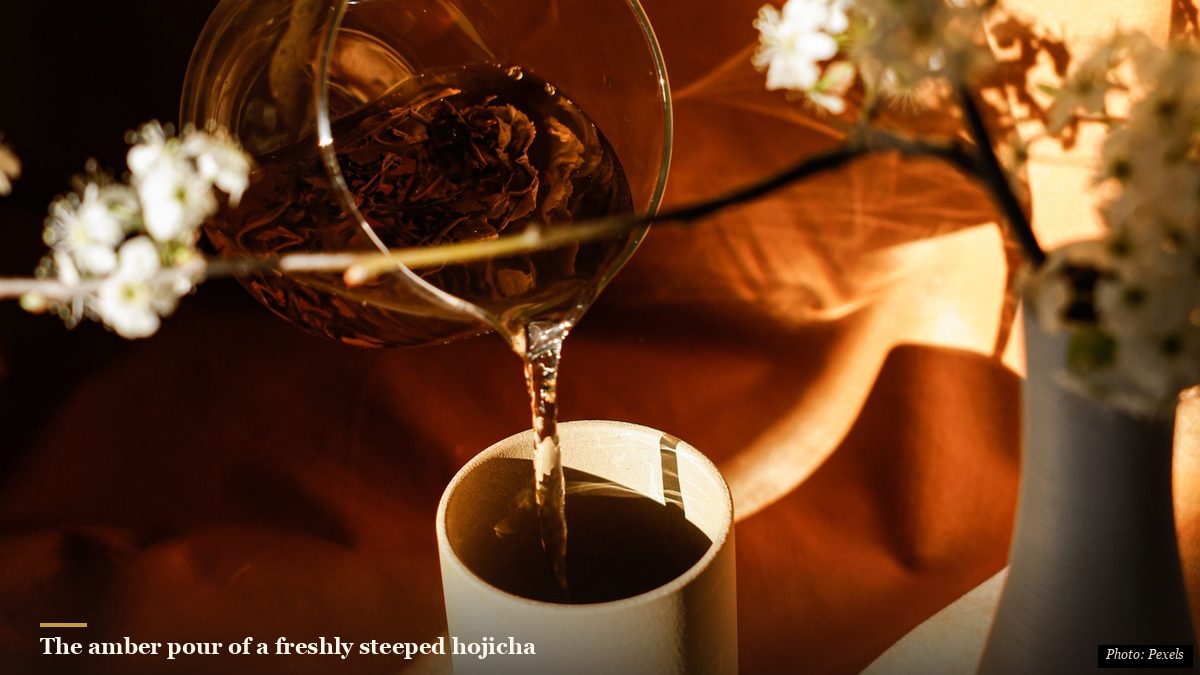
Hojicha is one of the most forgiving teas to brew, which is part of its everyday charm. Unlike delicate sencha, it is not easily ruined by hot water; it is typically steeped with near-boiling water (around 90–95 °C) for a short time and can be re-steeped. The result is a clear amber cup with a toasty, slightly sweet aroma and almost no bitterness. In many Japanese homes it is simply made by the potful and poured throughout a meal or an evening. Our brewing comparison walks through water temperature and timing in more detail.
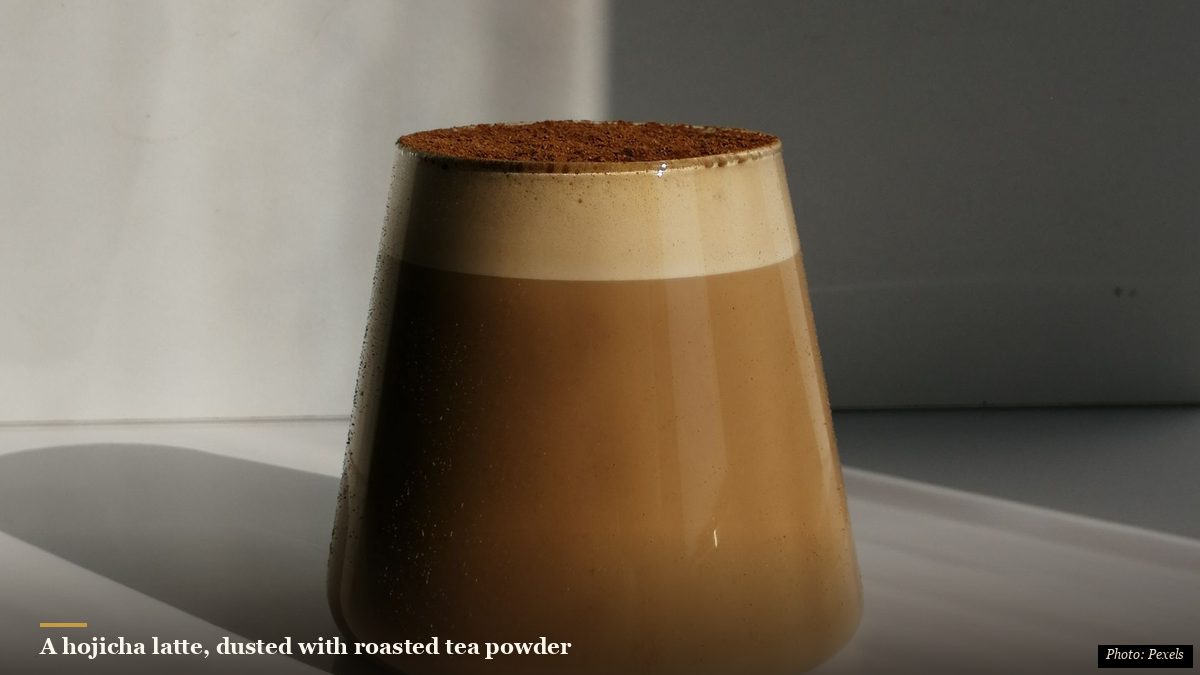
Beyond the plain brew, hojicha has become a favourite for lattes: its powdered form whisked with steamed milk makes a caramel-toned drink that has spread from Kyoto cafés around the world, and it appears in ice cream, custards, and pastries where its roasted note reads almost like a gentler coffee. Because it is warm, low in caffeine, and soothing to sip, many people fold hojicha into the quiet end of the day — the same niche occupied by the caffeine-light infusions we cover in our guides to bedtime herbal tea traditions and relaxation tea traditions of Asia. A pot of hojicha after dinner is, for many households, less a health measure than a signal to the body that the day is winding down. Individual responses vary considerably; what works well for one person may not suit another, and personal experimentation is always best done thoughtfully and, where relevant, under the guidance of a qualified practitioner.
Who Tends to Enjoy Hojicha Most?
Every tea has a natural audience, and hojicha's is unusually broad precisely because it asks so little of the drinker. It is the classic choice for the evening, when a full-caffeine sencha or coffee would be unwelcome, which places it comfortably among the calming, wind-down rituals described in our guide to nighttime wellness habits in Asia. It is traditionally offered to children and older family members in Japan, both because of the low caffeine and because its mild, sweet taste is easy to like. And it suits anyone who is simply caffeine-sensitive or who wants the comfort of a warm cup without the jitter.
Culturally, hojicha sits inside the much larger world of Japanese tea, from the meditative matcha tea ceremony to the everyday teas served with meals, and it reflects the same values of care, seasonality, and restraint that run through Kampo and Japanese wellness traditions and the unhurried habits explored in our guide to Japanese healthy-aging traditions. For those building a daily rhythm around tea, hojicha is often the anchor of the evening pot — a theme we return to in our guide to daily herbal tea rituals. And if you enjoy placing it in the wider regional picture, our overview of traditional Asian herbal teas shows where roasted green tea fits among the continent's many infusions.
Important Limitations and Considerations
Hojicha is, for most people, one of the gentlest teas to enjoy — but "gentle" is not the same as "risk-free," and a responsible guide has to note where care matters.
- It still contains caffeine. Low is not zero. If you are highly caffeine-sensitive, pregnant or breastfeeding, or drinking it very late, the modest caffeine can still be felt. Health agencies advise keeping caffeine intake moderate during pregnancy and breastfeeding (NCCIH). Individual responses vary widely.
- Concentrated extracts are a different matter. Drinking hojicha as a beverage is not the same as taking concentrated green-tea extract capsules. The NCCIH notes that concentrated green-tea extracts have been linked to liver injury in susceptible individuals and can interact with medications such as nadolol, atorvastatin, and raloxifene (NCCIH). Speak with a healthcare professional before using any concentrated supplement.
- Medication and health conditions. If you take prescription medication or manage a health condition, it is sensible to check with your doctor or pharmacist before making any tea a large daily habit, as caffeine and tea polyphenols can interact with certain drugs.
- Quality and freshness vary. Because hojicha is roasted, poorly stored tea can taste flat or stale. Buy from reputable sources and keep it airtight and away from light and moisture.
- It is a food, not a remedy. Enjoy hojicha as the warm, low-caffeine beverage it is. It is not a treatment for any condition, and it should never replace medical care.
Individual experiences vary considerably. The safest way to explore hojicha is the ordinary one: brew a pot, notice how it makes you feel, and involve a licensed practitioner before making any concentrated preparation part of a health routine.
Frequently Asked Questions
Is hojicha the same as green tea?
Yes and no. Hojicha is made from green tea — usually bancha, sencha, or twig tea — so it starts as green tea, but roasting transforms it so completely that it looks, smells, and tastes quite different: amber rather than green, toasty rather than grassy, and much less bitter. In that sense it is best thought of as roasted green tea, a distinct category with its own character. Our hojicha vs green tea guide covers the differences in full.
Does hojicha have caffeine?
It has some, but noticeably less than most teas. A standard infusion contains roughly 20 mg of caffeine per 100 mL — below sencha and well below matcha or coffee — because it is often made from lower-caffeine leaves and stems and because roasting drives some caffeine off. It is a popular evening choice for this reason, but it is not caffeine-free, so highly sensitive drinkers should still take care late at night.
What does hojicha taste like?
Hojicha tastes toasty, warm, and gently sweet, with notes often described as caramel, roasted nuts, toasted rice, or even a hint of woodsmoke. Crucially, it has very little of the bitterness or astringency of fresh green tea, because roasting breaks down much of the astringent EGCG. This mildness is a large part of why it appeals to people who find other green teas too sharp.
Can I drink hojicha before bed?
Many people do, precisely because its caffeine is low and its warmth is soothing. That said, low is not none — if you are sensitive to caffeine you may still notice it. Some people enjoy it as part of a wind-down ritual alongside other calming, caffeine-light drinks covered in our guide to bedtime herbal tea traditions. Individual responses vary, so it is worth seeing how a small evening cup sits with you.
Is hojicha good for children?
In Japan, hojicha is traditionally the tea offered to children and older family members, chosen for its low caffeine and mild, sweet taste. As with any caffeinated drink, moderation matters and parents should use their judgement, but its gentle profile is exactly why it has long been the family teapot's everyday choice.
What is the difference between hojicha and matcha?
They sit at opposite ends of the Japanese tea spectrum. Matcha is shade-grown, stone-milled into a bright green powder, whisked, and consumed whole, making it intense, vegetal, and relatively high in caffeine. Hojicha is roasted, brewed like a normal tea (or made into a milder powder), amber-coloured, toasty, and low in caffeine. Our complete guide to matcha explores the other end of the spectrum.
Is hojicha powder the same as matcha?
No. Both are powders, but hojicha powder is simply roasted green tea that has been finely ground, giving a caramel-toned, low-caffeine drink, while matcha is unroasted, shade-grown tea milled to a fine green powder with a stronger, more bitter flavour and more caffeine. Hojicha powder makes a mellow, comforting latte; matcha makes a vivid, energising one.
A Note on Tracking Your Tea Ritual
Japanese tea culture has always rewarded attention — noticing how a particular cup, at a particular time of day, actually makes you feel. Hojicha lends itself especially well to this, because so much of what it offers is sensory: the aroma as it steeps, the warmth in the evening, the way an after-dinner pot settles the household. If you decide to make hojicha a regular part of your routine, it can be quietly illuminating to keep a simple note — in a journal or an app — of when you drink it and how it fits your day, rather than expecting any dramatic effect. If you are curious where your own tastes fall within the wider world of Japanese tea, you might enjoy the short interactive Japanese tea quiz linked with this article. Tracking here is not about chasing outcomes; it is about coming to know your own patterns and preferences.
A Soft Closing Note
Hojicha began as an act of thrift — a way to keep humble leaves and stems from going to waste — and grew into one of Japan's most comforting everyday pleasures. That modest origin is part of its appeal: it asks nothing of you, keeps you awake for nothing, and gives back warmth, aroma, and a gentle place to end the day. Approached with curiosity and a clear sense of its limits, it is a lovely window into how Japanese tea culture turns care and restraint into something you can taste. Some people explore it by starting with a single evening pot and following one thread outward — the roasting story, the styles, the latte — through the guides linked throughout this hub. And if you enjoy comparing traditions, our companion complete guide to matcha makes a natural next stop, tracing the same tea plant to a very different cup.
About This Article
Written by: Health Diary Editorial Team — a group of writers focused on traditional Asian wellness, tea culture, and culturally grounded, responsibly sourced health content.
Editorial review: This article has been reviewed by the Health Diary editorial team for clarity, structure, and adherence to our sourcing standards. Key claims were cross-checked against NIH PubMed/PMC, NCCIH, the Cleveland Clinic, and native-language Japanese sources including NARO (the Japanese National Agriculture and Food Research Organization) and Ito En. It is not a clinical review and should not replace consultation with a licensed healthcare practitioner.
Reviewed on: August 3, 2026.
Editorial process: We cite peer-reviewed and government sources where possible, alongside primary Japanese-language references. When a clinical reviewer is added to this article, attribution will appear here with verifiable credentials.
References
- Chen Y, et al. Evaluation of Roasting Effect on Selected Green Tea Volatile Flavor Compound and Pyrazine Content by HS-SPME GC-MS. Applied Sciences. 2021;11(17):8217. mdpi.com
- Qin W, Ketnawa S. Exploring the Bioaccessibility of Roasted Japanese Green Tea: Impact of Simulated Gastrointestinal Digestion. Foods. 2025;14(2):311. PMC11764797
- Unno K, Ikka T, Yamashita H, et al. Stress-Relieving Effects of Japanese Green Tea: Evaluation Using the Molar Ratio of Caffeine and Epigallocatechin Gallate to Theanine and Arginine as an Indicator. Foods. 2025;14(1):103. PMC11720457
- Wang R, et al. Combined effect of pH and temperature on the stability and antioxidant capacity of epigallocatechin gallate (EGCG) in aqueous system. Journal of Food Engineering. 2019. sciencedirect.com
- Green Tea. National Center for Complementary and Integrative Health (NCCIH), National Institutes of Health. nccih.nih.gov
- 10 Reasons Green Tea Is Good for You. Cleveland Clinic. health.clevelandclinic.org
- 焙煎された茶に含まれる香気寄与成分 (Aroma-contributing compounds in roasted tea). 農研機構 (NARO), Vegetable and Tea Science Division. naro.go.jp
- お~いお茶 ほうじ茶 (Hojicha product information). 伊藤園 (Ito En). itoen.jp
- ほうじ茶 (Hojicha). Japanese-language reference. ja.wikipedia.org
This article is for educational purposes only and reflects traditional Japanese cultural practices. It does not constitute medical advice. Consult a qualified healthcare provider before starting any herbal practice or making changes to your health routine.


