

Traditional Asian Food Therapy: Food as Medicine in Asia
A pillar guide to traditional Asian food therapy — the yao shi tong yuan idea that food is medicine across China, Vietnam, Japan, and Korea, with soups, seasonal eating, and tonic foods.
Medical Disclaimer: This content is for educational and informational purposes only and is not medical advice. The information presented is not intended to diagnose, treat, cure, or prevent any disease. Always consult a licensed healthcare practitioner before starting any new herbal or dietary practice. Statements regarding traditional food and herbal use have not been evaluated by the FDA.
Affiliate Disclosure: This article contains affiliate links. We may earn a commission if you purchase through these links, at no additional cost to you. We only recommend products we believe align with our editorial standards.
In much of East and Southeast Asia there is no hard wall between the kitchen and the medicine cabinet. A bowl of ginger chicken soup on a cold day, a summer tea of chrysanthemum and goji, a pot of glutinous rice steamed with jujubes and chestnuts — these are ordinary meals, yet each is also understood as a small act of self-care, chosen for what it is thought to do rather than only for how it tastes. That intuition has a name. In Chinese it is yao shi tong yuan (药食同源), “medicine and food share the same source”; Koreans call the same idea yaksikdongwon, the Japanese express it through yakuzen, and Vietnamese practitioners of traditional medicine speak of dược thiện. Different words, one old conviction: that everyday eating, done thoughtfully, is the first and gentlest layer of keeping well.
This page is a map of that whole tradition. It traces where the “food is medicine” idea came from, how Asian food therapy reads a food through the lens of temperature and flavor, how it changes with the seasons, and how the same philosophy took four distinct culinary shapes across China, Vietnam, Japan, and Korea. Along the way it links out to deeper guides on the individual soups, tonics, and seasonal foods that make up the wider collection, so you can follow whichever thread pulls at you. Think of this article as the trunk of a tree; the linked pieces are its branches. And a note before we begin: this is a cultural and culinary tradition, not a treatment plan — a way of eating with intention, not a substitute for professional care.
What Is Traditional Asian Food Therapy?
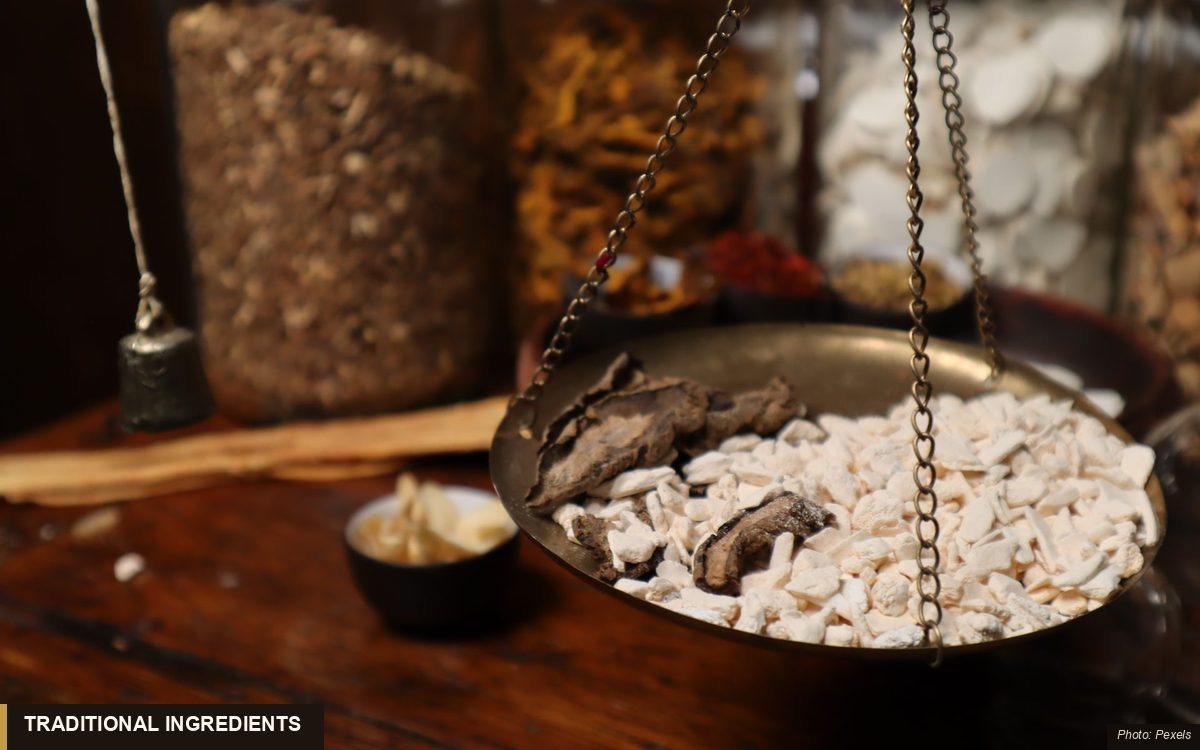
At its simplest, traditional Asian food therapy is the practice of choosing and preparing everyday foods according to the same framework a herbalist uses to think about herbs — then eating them as ordinary meals. The Chinese phrase for its founding premise, yao shi tong yuan, captures the point neatly: many of the plants in the apothecary drawer also live in the pantry, and the line between “food” and “remedy” is one of degree and intention, not of category. A Tang-dynasty commentary put it memorably — a substance “eaten on an empty stomach is a food; eaten by the unwell it becomes a medicine.”4
What makes it a therapy rather than just cooking is the framework underneath. Foods are read not by calories or vitamins but by a set of traditional qualities — whether they are warming or cooling, which flavors they carry, which organ systems they are believed to reach — and then matched to a person’s constitution and to the time of year. Chinese Dietary Therapy, one of the oldest expressions of the idea, has been practiced for more than three thousand years and is built explicitly on the principles of yin-yang, the five elements, and the homology of medicine and food.2 That same scaffolding — not any single “superfood” — is what unites the traditions surveyed on this page.
It helps to say clearly what food therapy is not. It is not a claim that a soup can replace a doctor, and it is not a promise of specific outcomes. The modern scholarly framing describes a shift from an old, almost unconscious habit of “food-like supplementation” toward a conscious, personalized approach oriented toward prevention and everyday balance rather than emergency intervention.3 Read that way, food therapy is less a pharmacy than a philosophy of attention — a habit of asking what a particular body, on a particular day, in a particular season, might be nourished by.
Where Did the Idea That Food Is Medicine Come From?
The lineage is remarkably long and unusually well documented. The earliest thread reaches back to the Zhou dynasty, whose court records in the Rites of Zhou describe a class of official shi yi (食医), or “dietary physicians,” ranked above the doctors who treated illness — a bureaucratic hint that managing the emperor’s food was considered the first line of keeping him well.4 The foundational medical classic, the Huangdi Neijing (“Yellow Emperor’s Inner Classic”), later distilled the dietary ideal into a famous formula: “grains for nourishment, fruits for assistance, meats for benefit, vegetables for filling — taken together with their qi and flavors to replenish essence.”4 It is one of the oldest surviving descriptions of a balanced, plant-forward plate.
The tradition found its great systematizer in the Tang-dynasty physician Sun Simiao. His Beiji Qianjin Yaofang (“Prescriptions Worth a Thousand Gold,” 654 CE) contains what is generally regarded as the first dedicated chapter on shi zhi — treating with food — cataloguing 155 fruits, vegetables, grains, and animal foods and insisting on an order of operations that still defines the tradition: a good physician “first understands the source of the illness… and corrects it with food; only when food fails does he turn to medicine.”4 A generation later, Sun’s student Meng Shen expanded the food chapters into the Shiliao Bencao (“Materia Medica for Dietary Therapy”), traditionally counted as China’s first book devoted entirely to food therapy.6
From there the idea kept branching. The Yuan-dynasty imperial dietitian Hu Sihui compiled dietary guidance for the Mongol court and recommended seasonal adjustment as a matter of course — cooling mung beans in the heat of summer, warming mutton and chicken in winter to drive out cold.6 These same organizing ideas — the ones that turn a pantry into a system — are the subject of our companion guide to traditional Chinese herbal traditions, which follows the herbal, apothecary side of the same worldview.
How Does Food Therapy Read a Food?
To a cook trained in this tradition, a piece of ginger or a handful of mung beans carries a short profile that has almost nothing to do with a nutrition label. Two qualities do most of the work, and both come straight from classical theory.
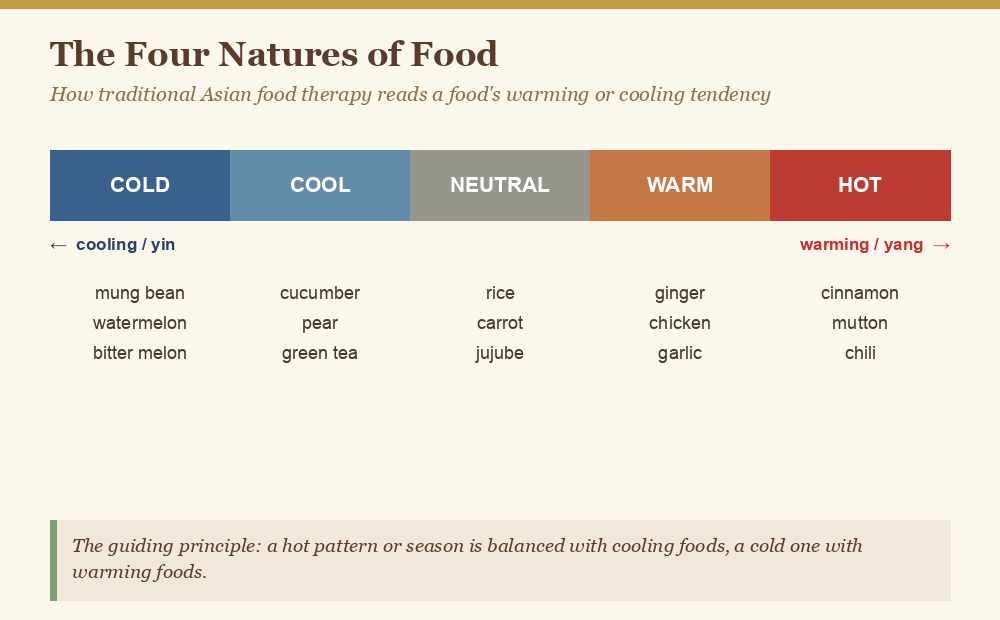
The first is nature, sometimes called the “four natures” or thermal quality: every food sits somewhere on a temperature scale from cold through cool, neutral, warm, and hot.2 This is not the literal temperature of the dish but its perceived effect on the body: watery, pale, low-calorie foods such as cucumber, mung bean, and most leafy greens read as “cooling,” while richer, warming foods such as ginger, mutton, and cinnamon read as “heating.”6 The guiding logic is elegantly simple: a person or a season running hot is balanced with cooling foods, and a cold pattern with warming ones. That balancing of opposites is the culinary face of yin-yang theory, which we unpack in our guide to yin-yang theory.
The second quality is flavor — the five flavors of sour, bitter, sweet, pungent, and salty. Here too the point is less the taste on the tongue than the direction of action each flavor is traditionally thought to encourage: pungent foods disperse, sour ones gather, bitter drains downward, sweet harmonizes and nourishes, salty softens. Each flavor is also linked to one of the five elements and to a particular organ system, so a practitioner reading a menu is really reading a web of correspondences. That five-fold map is the heart of our guide to five elements theory. Read together, nature and flavor let a traditional cook do something a calorie count never could: match a specific food to a specific body in a specific season.
Eating With the Seasons
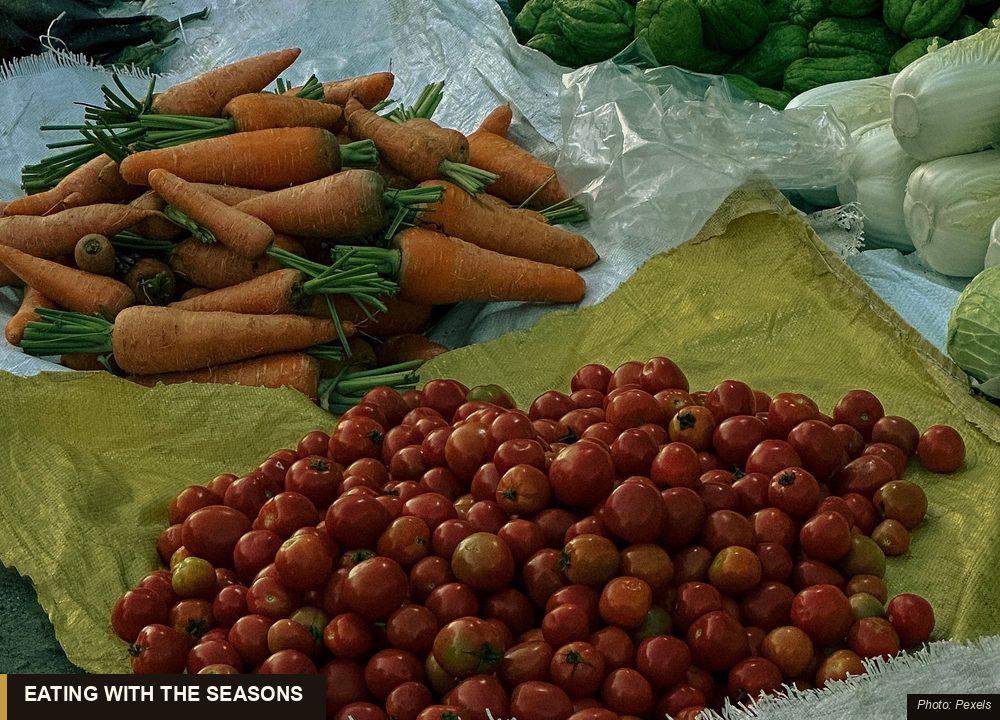
If there is one habit that defines Asian food therapy in daily life, it is eating with the seasons. The reasoning follows directly from the hot-cold framework: as the weather swings between extremes, the body is thought to need foods that pull it back toward the middle. Hu Sihui’s medieval advice — cooling foods in summer, warming foods in winter — is still the everyday rhythm of kitchens across the region.6
Each season has its own logic. In spring, as things wake up, the emphasis falls on gentle, upward-moving, green foods that suit the season of renewal — explored in our guide to spring foods in Asian traditions. Summer calls for cooling, hydrating dishes to counter the heat, the subject of our guide to cooling foods for summer. Autumn, considered a dry season, turns toward moistening, gathering foods — pears, white fungus, lotus — covered in our guide to autumn nourishing foods. And winter is the season of warming, restorative eating, when slow-cooked meats and warming spices come into their own, as described in our guide to warming winter foods.
One of the tradition’s most beloved seasonal quirks captures the whole spirit of the practice. In Korea, the hottest days of summer — the sambok — are precisely when many people eat a piping-hot bowl of ginseng chicken soup, a habit summed up in the phrase ivl chi yeol, “fighting heat with heat,” the idea being that a warming, restorative meal helps the body cope with the drain of extreme summer.12 It is a perfect example of food therapy’s counter-intuitive, pattern-based thinking — and a reminder that these choices are cultural wisdom to enjoy, with individual responses always varying from person to person.
Soups and Broths: The Heart of Asian Food Therapy
If food therapy has a signature form, it is the slow-simmered soup. A pot of broth is the ideal vehicle for the tradition: it draws out the qualities of roots, dried fruits, and gentle herbs into an easily digestible, warming liquid, and it turns “taking a remedy” into the comforting ritual of sharing a meal. Across the region, these nourishing soups — the whole family of them — are gathered in our overview of traditional Asian tonic soups, a natural next stop from this page.
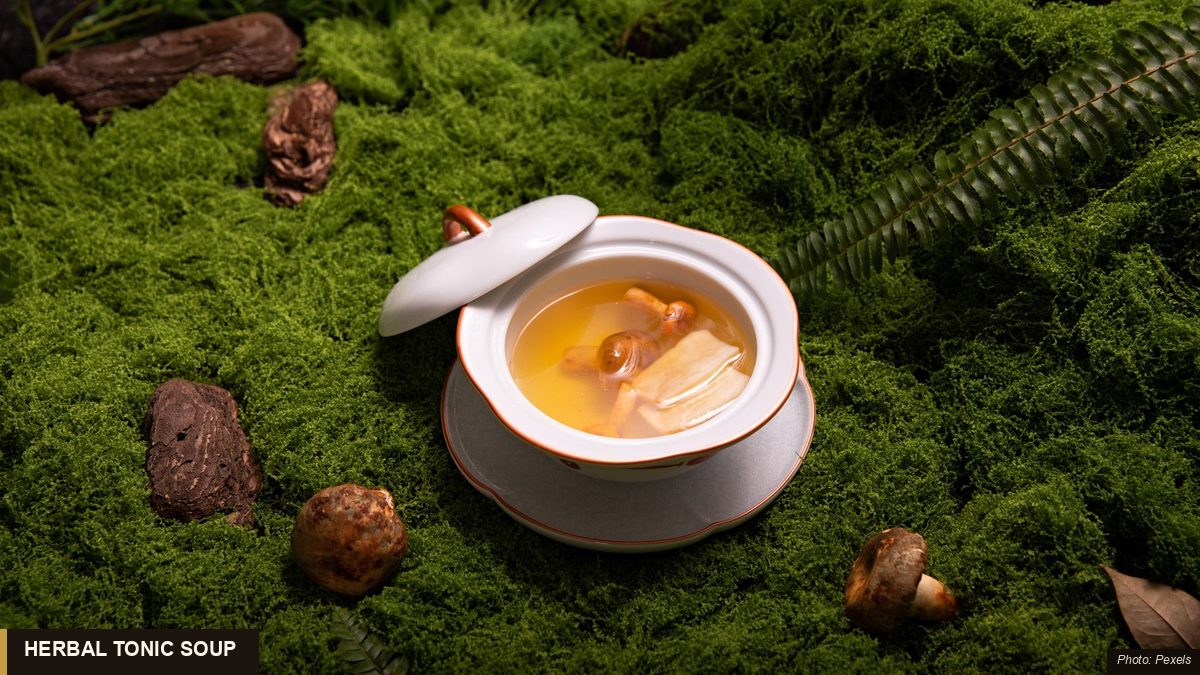
The individual soups each tell part of the story. The most iconic warming broth is ginger chicken soup, a near-universal comfort dish across Asian traditions. For a gentler, restorative style there is the classic pairing of red date and longan soup, long enjoyed as a sweet, blood-nourishing tonic, and the bright, eye-associated goji berry soup. On the sweeter, cooling side sits lotus seed sweet soup, a summer favorite traditionally linked with calm and rest. And no survey would be complete without Vietnam’s own contribution — the Vietnamese herbal soups that carry the dược thiện philosophy into everyday home cooking, from gà hầm thuốc bắc (chicken stewed with tonic herbs) to restorative fish soups. Individual responses vary considerably; a soup that suits one person’s constitution may be poorly matched to another’s, and any regular practice is best undertaken with practitioner guidance.
Tonic Foods and Longevity Eating
Beyond the seasonal and the everyday sits a special category the tradition treats with real reverence: bu (补) foods, the tonic or “restorative” ingredients traditionally eaten to replenish vitality over the long term. These are the ginseng roots, astragalus slices, black sesame, walnuts, jujubes, and mushrooms that recur again and again in dishes meant less for a single meal than for a life lived well. Many are drawn from the official Chinese “food-and-medicine substance” directory — a modern government list of roughly a hundred items, from ginseng to goji to jujube, formally recognized as usable both as food and as traditional medicine.11
The most storied of them all is ginseng, the root that sits at the very center of Asian tonic cooking; its long cultural history is traced in our complete guide to ginseng and its place in the wider system in our overview of ginseng in traditional Eastern wellness. This whole family of vitality-oriented ingredients — and the cultural ideal of eating for a long, steady life — is the subject of our guide to traditional longevity foods of Asia. Even a warming cup counts here: the turmeric golden drinks that have spread far beyond Asia belong to the same instinct to fold gentle, aromatic ingredients into daily nourishment. None of this implies that any single food extends life; the tradition’s wager is subtler — that consistent, balanced, intentional eating is itself a form of care.
One Philosophy, Four Kitchens
What makes Asian food therapy so rich is that a single shared idea grew into four distinct culinary cultures, each with its own vocabulary and signature dishes. Seeing them side by side is the clearest way to appreciate the tradition’s reach.
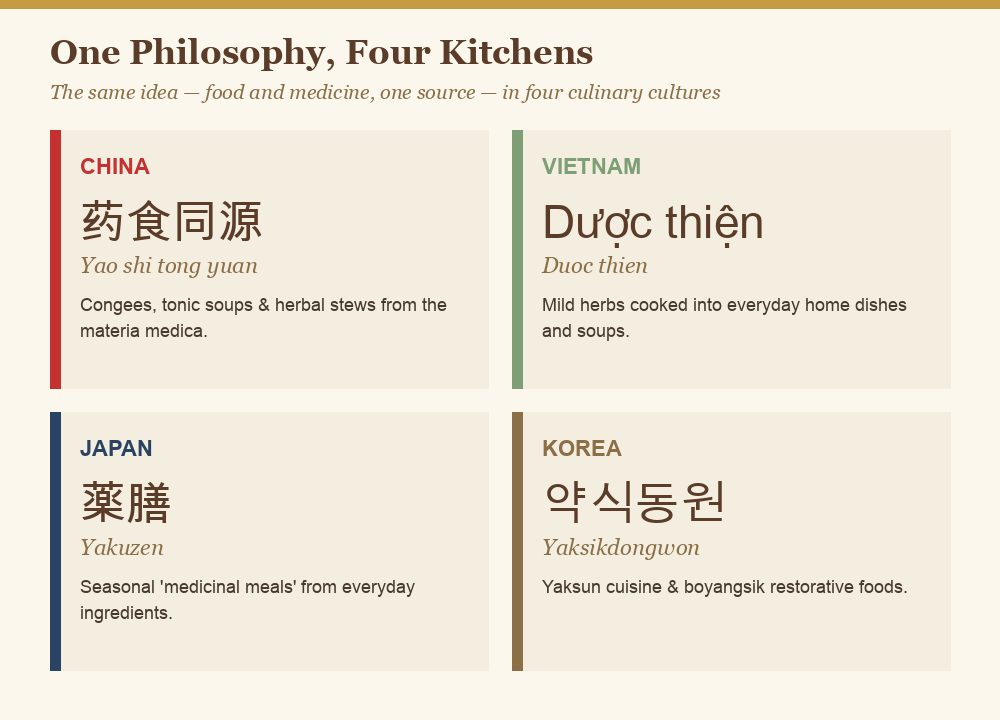
In China, the source tradition, food therapy is inseparable from the broader materia medica — the congees, tonic soups, and herbal stews that translate the apothecary’s logic onto the dinner table, described throughout our Chinese herbal traditions guide. In Vietnam, the same principle is called dược thiện — the art of cooking mild-natured herbs into everyday dishes, guided by four principles of safety, nourishment, palatability, and matching the eater’s pattern of cold or heat, deficiency or excess.7 Its everyday face is a bowl of Vietnamese herbal soup.
In Japan, the tradition took the name yakuzen (薬膳) — literally “medicinal meal.” Japanese sources draw a clean line between kampo, the herbal medicine of combined crude drugs, and yakuzen, the food built from everyday ingredients like ginger, daikon, and shiitake, chosen by the same four-natures-and-five-flavors reading and adjusted to season and constitution.8 And in Korea, the philosophy is yaksikdongwon — “food and medicine, one origin” — expressed through yaksun medicinal cuisine and the culture of boyangsik, restorative foods like ginseng chicken soup eaten to rebuild energy in demanding seasons.5 Four kitchens, four names — but read a menu in any of them through the lens of temperature, flavor, and season, and the same two-thousand-year-old grammar is unmistakably at work.
What Does Modern Research Say About Food Therapy?
Modern science approaches this tradition carefully, and the honest summary is that the picture is genuinely mixed. On the encouraging side, a 2025 systematic review of ninety-nine studies found that dietary patterns aligned with Chinese dietary therapy — emphasizing whole grains, vegetables, and fruit with limited meat — were associated with lower obesity risk and improved metabolic markers.2 That is not surprising: much of what food therapy has recommended for centuries — more plants, seasonal variety, gentle cooking, moderation — lines up comfortably with mainstream nutrition science.
Where researchers urge caution is in over-reading the tradition. The same review notes that evidence for firmer outcomes in cardiovascular disease, diabetes, and cancer remains inconsistent, limited by heterogeneous, largely observational study designs.2 The U.S. National Center for Complementary and Integrative Health strikes a similar note about traditional Chinese practices generally: some components show promise, but studies of the herbal side in particular have had mixed results, and firm conclusions are often limited by study quality.1 Meanwhile the concept of “medicine-food homology” has become an active research field in its own right, with scientists probing whether specific food-medicine ingredients carry measurable, if modest, preventive value — while emphasizing that these are mild, food-based interventions, not drug replacements.3
The tradition’s global standing is nonetheless rising. In 2019 the World Health Organization added a dedicated Traditional Medicine chapter to the 11th revision of the International Classification of Diseases, drawing on Chinese, Japanese, Korean, and Vietnamese practices — framed not as an endorsement of efficacy but as a way to standardize terminology and finally gather comparable international data.9 In short: the world is studying food therapy more seriously than ever, which is exactly why responsible sources resist tidy promises in either direction.
Important Limitations and Considerations
Traditional Asian food therapy is a rich cultural and culinary tradition, not a substitute for professional medical care. Several cautions deserve genuine attention before anyone leans on it.
- Food therapy is not treatment. Enjoying a tonic soup is not the same as managing a medical condition. If you have symptoms that concern you, see a qualified clinician — do not rely on dietary adjustments in place of diagnosis and care.
- Some “food” herbs still interact with medications. Ingredients that blur the food-medicine line — ginger, licorice, angelica (dong quai), and others — can affect bleeding and interact with drugs such as blood thinners. If you take any prescription medication, talk to your doctor or pharmacist before adding tonic herbs to your cooking.
- Quality and sourcing vary. Health authorities have documented cases of imported herbal products contaminated with undeclared drugs, heavy metals, or pesticides, and of one herb being mistakenly substituted for another.1 Buy tonic ingredients from reputable suppliers.
- Pregnancy, breastfeeding, and children. Many traditional tonic herbs have not been well studied in these groups, and some are traditionally avoided during pregnancy. Consult a qualified practitioner first.
- Constitution matters. The tradition itself warns that a food ideal for one pattern can be wrong for another — the Vietnamese dược thiện principle of matching food to a person’s hot/cold, deficient/excess pattern exists precisely because there is no one-size-fits-all diet.7
Individual experiences vary considerably, and the safest way into this tradition is a slow, curious one taken alongside your regular healthcare.
Frequently Asked Questions
What does “yao shi tong yuan” actually mean?
It is a Chinese phrase, 药食同源, usually translated as “medicine and food share the same source.” The idea is that many plants used as remedies are also foods, so the boundary between eating and self-care is one of degree and intention rather than a hard line. Korea expresses the same idea as yaksikdongwon and Japan through yakuzen.
Is Asian food therapy the same as traditional Chinese medicine?
Food therapy is one branch of the wider traditional system, sharing its core concepts — yin-yang, the five elements, and the hot-cold classification of ingredients — but applying them to ordinary meals rather than to prescribed herbal formulas. You can enjoy the food side, like a nourishing soup, while keeping conventional medicine as your primary care.
How do I know if a food is “warming” or “cooling”?
Traditional sources classify foods by their perceived effect on the body rather than their temperature. As a rough guide, richer and more pungent foods such as ginger, cinnamon, and mutton are considered warming, while watery, pale foods such as cucumber, mung bean, and most leafy greens are considered cooling. Reference charts vary, so treat any single list as a starting point, not a rule.
Can I practice food therapy if I’m not Chinese, Vietnamese, Japanese, or Korean?
Yes. The framework is about qualities of food and seasons, not about a specific cuisine, and many of its principles — eat more plants, vary food with the seasons, favor gentle cooking, match meals to how you feel — travel easily. The most respectful approach is to learn the ideas from their source traditions rather than treating individual foods as isolated “superfoods.”
Does food therapy work, according to science?
The evidence is mixed and still developing. Dietary patterns aligned with food therapy — plant-forward, seasonal, moderate — line up well with mainstream nutrition advice, and one 2025 review of ninety-nine studies linked them to lower obesity risk. But evidence for firmer disease-related outcomes remains inconsistent, so bold promises are not warranted. Treat food therapy as a gentle, everyday framework, not a proven remedy.
Are tonic soups safe to eat regularly?
For most healthy people, gentle everyday tonic soups made with food-grade ingredients are enjoyed regularly across Asia with little concern. The cautions apply to stronger tonic herbs, to people on medications, and to pregnancy. If you take prescription drugs or have a health condition, check with a healthcare practitioner before making concentrated herbal soups a routine habit.
Where should I start if I’m new to all of this?
A gentle entry point is a single seasonal habit — a cooling soup in summer, a warming one in winter — using ordinary, food-grade ingredients. From there you can explore the linked guides to individual soups and to the underlying concepts of yin-yang and the five elements. Start small, notice how you feel, and let curiosity rather than any promised outcome guide you.
A Note on Tracking Your Wellness Journey
One idea that Asian food therapy and modern wellness share is that patterns matter more than single meals. A traditional practitioner reads how your energy, digestion, sleep, and mood shift across days and seasons — and you can bring that same attentiveness to your own table. Keeping a simple record of which foods and seasonal habits genuinely seem to suit you, and which do not, turns vague memory into something useful — information far more valuable to share with a practitioner than a hazy recollection. This kind of gentle, long-view self-observation is exactly what the Health Diary approach is built around.
A Soft Closing Note
Traditional Asian food therapy is best appreciated not as a shortcut or a set of miracle foods but as a two-thousand-year-old habit of paying close attention — to ingredients, to seasons, and to the particular person at the table. Whether you arrived here curious about a single soup or about the whole philosophy, the branches of this collection are yours to wander: the founding ideas of yin and yang and the five elements, the comforting tonic soups that carry them, or the longevity foods eaten across the region for a long, steady life. Explore slowly, stay curious, and let a qualified practitioner and your own regular healthcare guide any step you take.
About This Article
Written by: Health Diary Editorial Team — researchers specializing in Asian wellness traditions, herbal history, and food culture.
Editorial review: This article has been reviewed by the Health Diary editorial team for clarity, structure, and adherence to our sourcing standards. Key claims were cross-checked against NCCIH, the World Health Organization, and peer-reviewed literature, with native-language verification of classical provenance through the Journal of Nanjing University of Chinese Medicine (中文), the Ho Chi Minh City Hospital of Traditional Medicine (tiếng Việt), Japanese yakuzen sources (日本語), and the Journal of Ethnic Foods (한국어). It is not a clinical review and should not replace consultation with a licensed healthcare practitioner.
Reviewed on: August 3, 2026.
Editorial process: We cite peer-reviewed and government sources where possible. When a clinical reviewer is added to this article, attribution will appear here with verifiable credentials.
References
- National Center for Complementary and Integrative Health (NCCIH). “Traditional Chinese Medicine: What You Need To Know.” 2024. https://www.nccih.nih.gov/health/traditional-chinese-medicine-what-you-need-to-know
- “Chinese Dietary Therapy — Ancient Roots, Modern Evidence.” Center for Chinese Medicine research portal. 2024–2025. https://ccmu.edu/research/ancient-roots-modern-evidence/3-chinese-dietary-therapy/
- Zhou X, et al. “Transformation from traditional medicine-food homology to modern food-medicine homology.” Food & Medicine Homology. 2024. https://www.sciopen.com/article/10.26599/FMH.2024.9420014
- 王旭东 (Wang Xudong). “‘药食同源’的思想源流、概念内涵与当代发展 (The intellectual origins, conceptual meaning, and contemporary development of yao shi tong yuan).” 南京中医药大学学报 (J Nanjing Univ Chin Med). 2023. https://xb.njucm.edu.cn/cn/article/pdf/preview/10.14148/j.issn.1672-0482.2023.0809.pdf
- Kwon DY, et al. “Medicinal food understanding in Korean gastronomic culture.” Journal of Ethnic Foods. 2019. https://doi.org/10.1186/s42779-019-0003-9
- “Medicinal and historical value of Chinese food therapy.” Hektoen International — A Journal of Medical Humanities. 2018. https://hekint.org/2018/09/18/medicinal-and-historical-value-of-chinese-food-therapy/
- “Dược thiện — Dược liệu trong bữa ăn hàng ngày.” Bệnh viện Y học Cổ truyền TP.HCM. https://www.yhct.vn/tin-tuc/truyen-thong-y-te/kien-thuc-y-khoa/duoc-thien-duoc-lieu-trong-bua-an-hang-ngay-phan-1
- “What Is Yakuzen? The Meaning, How It Differs from Kampo, and How to Start with Everyday Ingredients.” Agriture Inc. https://agriture.jp/en/sustainable/yakuzen-guide/
- World Health Organization. “Traditional medicine (Classifications FAQ).” WHO. https://www.who.int/standards/classifications/frequently-asked-questions/traditional-medicine
- Zhang R, et al. “Renal Health Through Medicine–Food Homology: A Comprehensive Review of Botanical Micronutrients and Their Mechanisms.” Nutrients. 2024;16(20):3530. https://www.mdpi.com/2072-6643/16/20/3530
- “药食同源:中医药产业化的有效切入口 (Yao shi tong yuan and the food-and-medicine substance directory).” 新华健康 / China Daily. 2022. https://jx.chinadaily.com.cn/a/202204/01/WS6246c6a1a3101c3ee7ace98e.html
- “The Korean Health Secret: Nutritious Foods (Boyangsik).” VisitKorea — Korea Tourism Organization. https://english.visitkorea.or.kr/svc/contents/contentsView.do?vcontsId=187842


