

Traditional Wellness Practices Across Asia: Movement, Breath & Stillness
A guide to the traditional mind-body wellness practices of China, Japan, Korea, and Vietnam — tai chi, qigong, meditation, breathwork, and restorative rest.
Medical Disclaimer: This content is for educational and informational purposes only and is not medical advice. It reflects traditional Chinese, Japanese, Korean, and Vietnamese cultural practices and folk wellness traditions and is not intended to diagnose, treat, cure, or prevent any disease. Always consult a licensed healthcare practitioner before starting any new movement, breathing, or meditation practice. Individual results are not guaranteed.
Affiliate Disclosure: This article may contain affiliate links. We may earn a commission if you purchase through these links, at no additional cost to you. We only recommend products we believe align with our editorial standards.
Long before "wellness" became a marketing word, the cultures of East and Southeast Asia had built entire systems around a simple observation: how you move, how you breathe, and how you rest shape how you feel. From the slow, flowing forms of tai chi practised at dawn in a Chinese park, to the silent seated stillness of Japanese Zen, to the deep-belly breathing of a Vietnamese dưỡng sinh class, these traditions see body and mind as a single system to be tended, not two machines to be fixed.
This guide is the hub for our writing on traditional Asian wellness practices — the things people actually do. It maps the shared philosophy behind them, walks through the major families of practice, looks honestly at what modern research does and does not show, and points you toward deeper guides on each one. It is a doorway, not the last word.
What Are "Traditional Asian Wellness Practices"?
The phrase covers a broad family of mind-body practices — disciplines that deliberately link physical movement or posture, controlled breathing, and focused attention. Rather than isolating "exercise" from "relaxation" from "mental training," these traditions weave them together. A tai chi form is simultaneously gentle movement, breath practice, and a moving meditation.
Broadly, the region's practices fall into a few overlapping groups: moving arts such as tai chi and qigong; seated meditation such as Zen; breathwork centred on the lower abdomen; and restorative rituals such as bathing culture and time in nature. They rest on shared theory — the ideas of qi (vital energy), yin and yang, the five elements, and the body's meridian pathways — and they appear, with local flavour, in the Chinese, Japanese, and Korean wellness systems alike.
The Shared Idea — Qi, Breath, and Mind-Body Unity
If one thread ties these practices together, it is the concept of qi (氣) — a traditional idea of vital energy or life force. The character itself is thought to depict steam rising from cooking rice, a fitting image for something invisible yet animating. The concept grows out of Daoist philosophy and classical Chinese medicine, where health is described as qi flowing freely and in balance (Britannica, qigong).
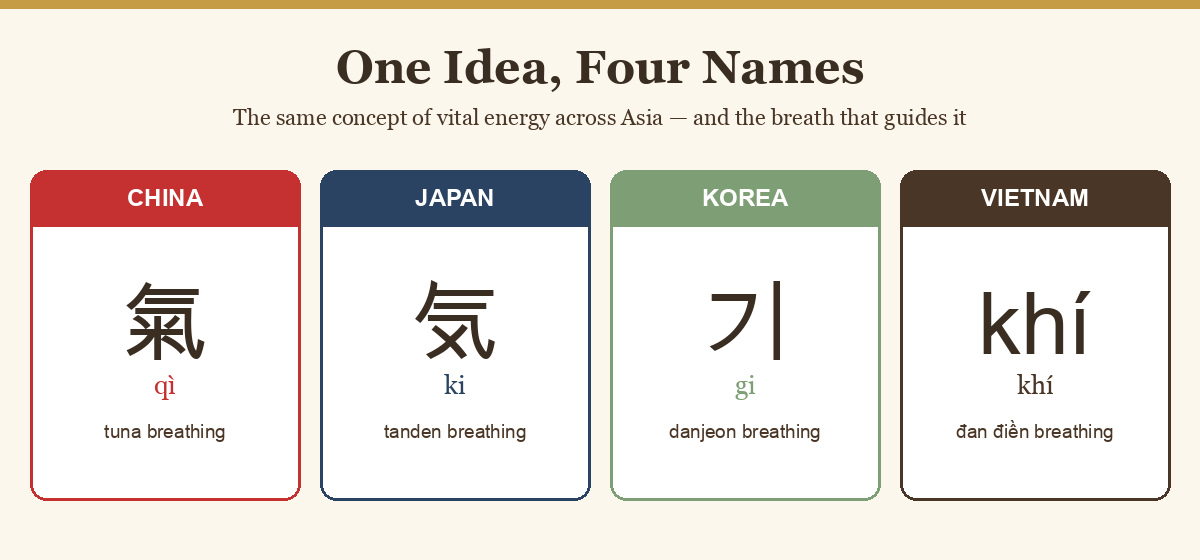
Remarkably, the same idea recurs across the region under different names: qi (氣) in China, ki (気) in Japan, gi (기) in Korea, and khí in Vietnam. In every case, the breath is treated as the practical handle on this energy — the one bodily rhythm we can consciously direct. Chinese practice speaks of tuna (吐纳, "expelling and drawing in"); Japanese and Korean traditions locate the breath in the tanden or danjeon (the lower abdomen, or dantian); and Vietnamese dưỡng sinh guides the breath deep to the đan điền (YHCT, khí công & dưỡng sinh). It is this "regulate the body, regulate the breath, regulate the mind" (调身 · 调息 · 调心) triad that defines the whole family (zhzyw, tai chi and qigong).
It is worth being clear-eyed here: qi is a cultural and philosophical framework, not a substance measured by modern instruments. Its value in these practices is as a language for attention, posture, and breath — and that language has organised some of the world's most enduring wellness habits.
The Major Families of Practice at a Glance
Before we look at each one in turn, it helps to see how the main practices relate. In real life they overlap and blend — a qigong set can feel like moving meditation, and a Zen sitting is also breath training — but each has its own centre of gravity, its own history, and its own best-studied uses.
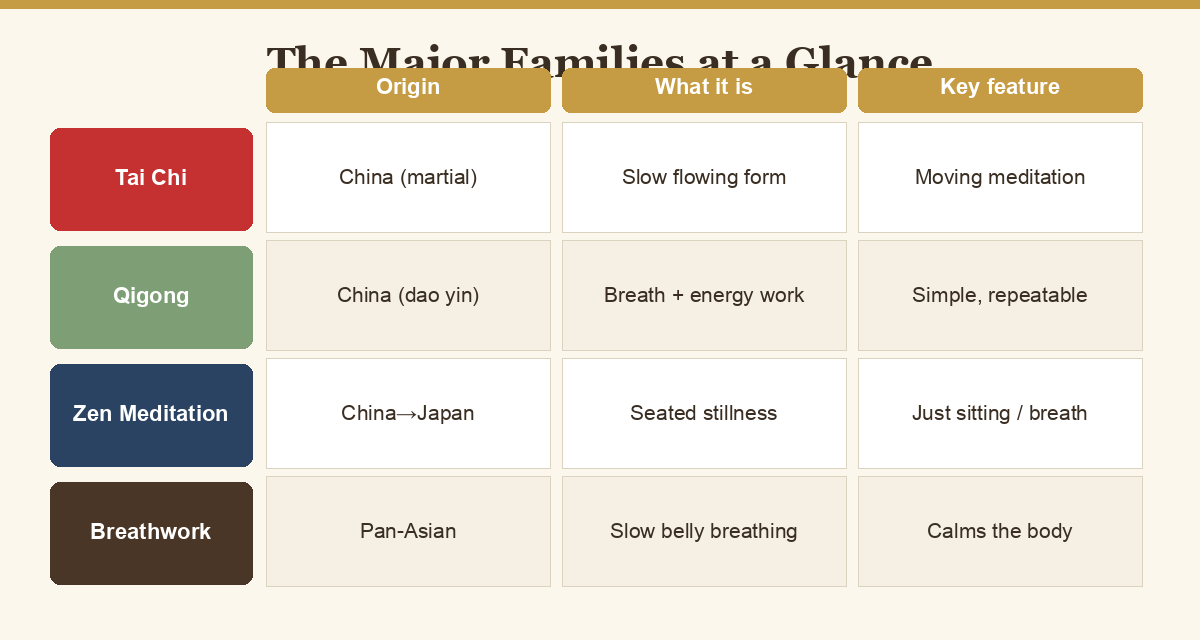
What unites them matters more than what separates them. Every practice in this guide asks the same three things of you: slow down, pay attention to the body, and let the breath lead. That shared foundation is why they sit so naturally alongside the region's other wellness habits — a calming cup from our daily herbal tea rituals, the seasonal rhythms of Asian food therapy, or an unhurried pot of traditional Asian tea.
Tai Chi — Meditation in Motion
Tai chi (太极拳, taijiquan) began as a Chinese martial art — the Chen family style of Chen Village is usually named as its cradle — and gradually evolved toward a gentle health practice (zhzyw). Today most people practise it for wellbeing rather than combat, moving through slow, continuous postures while breathing evenly and keeping the mind attentive. The US National Center for Complementary and Integrative Health aptly calls it a practice that combines "slow movements, a meditative state of mind, and controlled breathing" (NCCIH, Tai Chi).
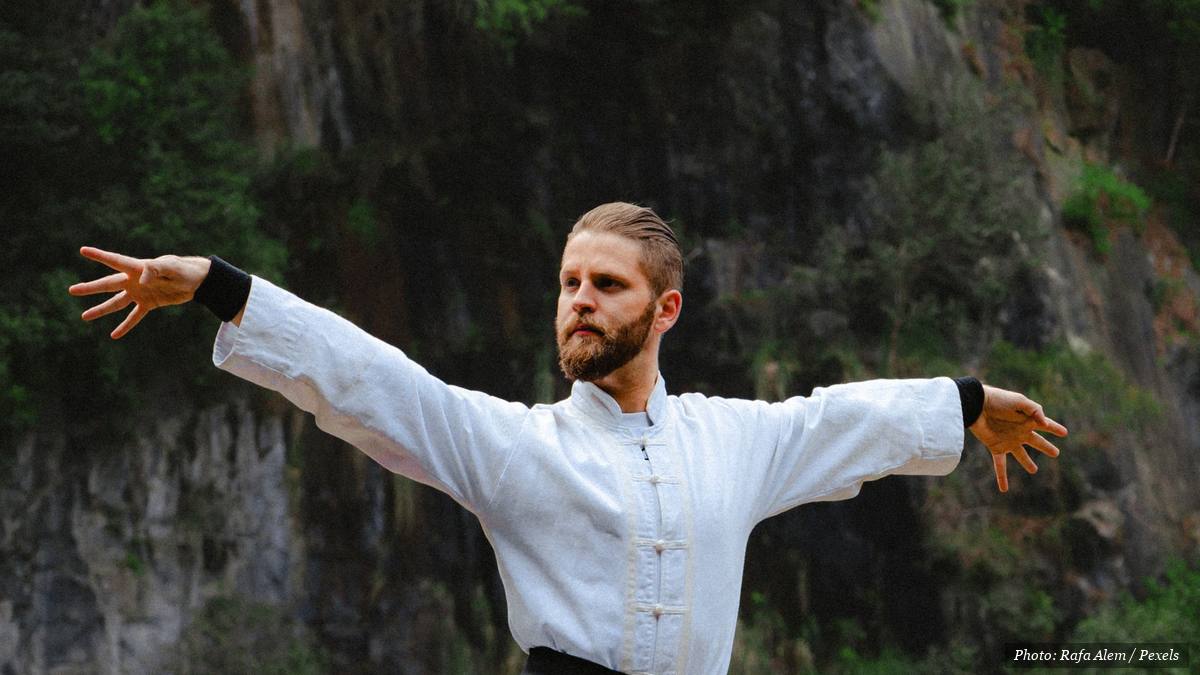
Over the centuries tai chi branched into several family styles — Chen, with its coiling power and occasional bursts of speed; Yang, the flowing, evenly paced style most people picture; and the more compact Wu, Sun, and Hao lineages. For a beginner the differences matter less than the shared essentials: an upright but relaxed spine, weight sinking into the feet, and one posture melting into the next without a hard stop. Because it is low-impact and adaptable, tai chi is one of the most accessible entry points into the whole tradition — you can begin with a handful of movements and a few minutes a day. Our tai chi for beginners guide walks through what a first practice looks like, and it pairs naturally with the longevity habits explored in our healthy aging traditions hub.
Qigong — Cultivating the Breath and Energy
Where tai chi is one structured form, qigong (气功, "energy work") is a much broader family of practices for cultivating qi through breath, gentle movement, and mental focus. Its roots reach back to dao yin ("guiding the qi"), a practice mentioned as early as the Zhuangzi around the 4th century BCE, and it later absorbed influences from Daoist, Buddhist, Confucian, medical, and martial traditions (History of qigong). Classical routines such as the Eight Pieces of Brocade (八段锦) are still practised today.
In practice, qigong tends to be simpler and more repetitive than tai chi — often a single movement or breathing pattern repeated — which makes it a gentle starting point. The NCCIH describes qigong as a practice developed within Chinese medicine to work with the body's energy through breathing, movement, and focus (NCCIH, Qigong). A typical session might involve standing quietly, letting the shoulders drop, and moving the arms in slow arcs coordinated with the breath — the Eight Pieces of Brocade, for instance, is a sequence of eight such movements, each said to "work" a different part of the body. The emphasis is less on athletic effort than on smoothness, ease, and the felt sense of the breath settling. Many people find even ten minutes leaves them noticeably calmer. Our qigong basics for beginners guide is the place to start; if you are unsure how it differs from tai chi, the short version is that qigong is the broader category and tai chi a specific, martial-descended form within it.
Meditation and Stillness — From Chan to Zen
Alongside movement sits the region's deep tradition of seated meditation. Chinese Chan Buddhism travelled to Japan as Zen, where the Sōtō school made shikantaza (只管打坐, "just sitting") the heart of practice — a posture-first meditation in which sitting attentively is the practice, with natural abdominal breathing through the nose (Sōtō Zen). The Rinzai school, by contrast, often works with breath-counting (susokukan) and kōan contemplation (Engakuji, Zen breathing).
The two great Japanese schools illustrate different doors to the same room. Sōtō Zen trusts the posture itself: you sit, you breathe naturally, and you let thoughts come and go without chasing them. Rinzai Zen gives the restless mind something to hold — counting breaths from one to ten and beginning again, or contemplating a kōan, a riddle with no logical answer. Neither is "better"; they suit different temperaments. These seated traditions and the moving arts are two expressions of the same aim — a settled, present mind. You can read more in our guide to the meditation traditions of Asia, and the overlap with movement is exactly why tai chi is so often called "meditation in motion."

How Does Breathing Calm the Body?
Breathwork is the quiet common denominator of every practice above. Across all four cultures, the instruction is strikingly similar: breathe slowly, deeply, and low — into the lower abdomen rather than the upper chest. Chinese tuna, Japanese tanden breathing, Korean danjeon breathing, and Vietnamese breathing to the đan điền are, in practical terms, the same gentle skill (Engakuji)(Korean mind-body study).
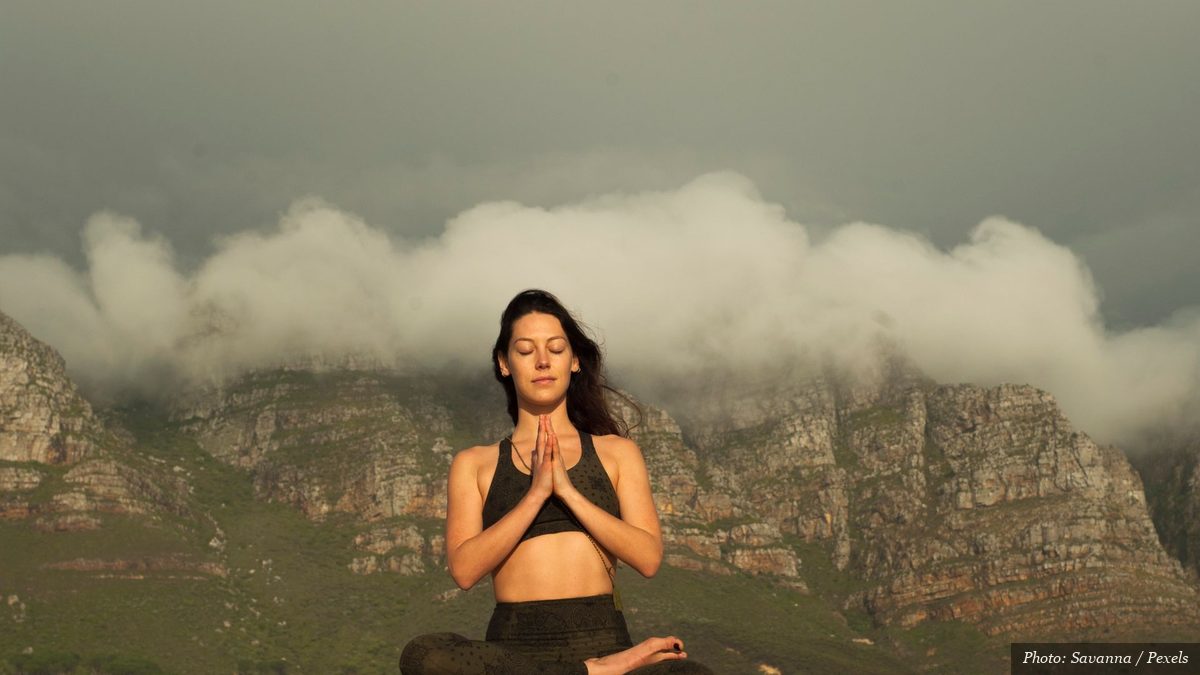
There is a plausible physiological thread here. A large 2022 systematic review found that voluntary slow breathing increases vagally-mediated heart-rate variability both during and after practice — a marker often associated with the body's "rest and digest" state (Laborde et al., 2022). In other words, the traditional instinct to slow the breath when seeking calm has a real mechanistic footing. Our guide to the breathing traditions of Asia goes deeper, and a warm cup from our relaxation tea traditions or bedtime herbal teas makes a natural companion to an evening breathing practice. Individual experiences vary considerably.
Rest and Restoration — Bathing, Nature, and Dưỡng Sinh
Not every practice is active. The region also treasures deliberate rest. Korea's communal bathing culture — from the historic mokyeoktang to the modern jjimjilbang — grew over centuries into a restorative social ritual, a place to slow down together (Korean bathing culture). Japan gave the world shinrin-yoku ("forest bathing"), a term coined by its forestry ministry in 1982 to describe unhurried, sensory time among trees; a 2019 meta-analysis associated forest settings with lower cortisol than urban ones, though the authors note considerable variation between studies (Antonelli et al., 2019). The practice asks for nothing athletic — no hiking goal, no step count — only unhurried, senses-open time among trees: noticing light through leaves, the smell of soil, the sound of wind. It is perhaps the gentlest reminder that "doing" a wellness practice can sometimes mean doing very little, on purpose.

Vietnam's dưỡng sinh ("nurturing life") tradition deserves special mention, since it is rarely covered in English. Systematised in the twentieth century by figures such as Nguyễn Khắc Viện and Nguyễn Văn Hưởng, it combines gentle movement, deep abdominal breathing, and relaxation, and defines healthy breath as "quiet, calm, gentle, and regulated" (YHCT, dưỡng sinh). This lineage of "nurturing life" runs deep in Vietnamese wellness, alongside the herbal side documented in our Vietnamese herbal traditions, and our traditional relaxation practices guide collects more of these restorative customs. It is worth framing these honestly as cultural and restorative rituals rather than medical treatments.
What Does Modern Research Say?
This is where honesty matters most. These practices are genuinely studied — and the findings are real but modest, often described by researchers themselves as low-certainty.
Tai chi, balance, and falls. The best-established finding is that tai chi may improve balance and lower the risk of falls in older adults. The NCCIH summarises the evidence as low-certainty but points to a possible reduction in fall rate of around 19% and in the number of people who fall of around 20% (NCCIH, Tai Chi), and recent meta-analyses of randomised trials point the same way (2023 meta-analysis).
Qigong and stress. Systematic reviews have associated qigong with reductions in anxiety and low mood and with improved psychological wellbeing, while consistently cautioning that the number of high-quality trials is still small (Wang et al., 2013)(Wang et al., 2014).
Meditation. The landmark 2014 JAMA Internal Medicine review of 47 trials found moderate evidence that mindfulness meditation can ease anxiety, low mood, and pain, and low or insufficient evidence for many other outcomes — a careful, hedged picture rather than a panacea (Goyal et al., 2014)(NCCIH, Meditation). Overall, the World Health Organization frames traditional and complementary practices as valuable but still in need of a stronger evidence base (WHO, 2019). Read the whole field with "may," "associated with," and "more research needed" in mind.
Important Limitations and Considerations
- These complement, not replace, medical care. No breathing or movement practice is a substitute for professional treatment, and none should delay it. Speak with your provider, especially if you have a health condition (NCCIH).
- Generally safe, with minor exceptions. A meta-analysis of tai chi trials found adverse events were minor and musculoskeletal — sore knees or backs — and no more frequent than in control groups (Cui et al., 2019).
- Frail or high-fall-risk beginners should start supervised. Anyone with osteoporosis, recent fractures, or a high fall risk is wise to begin with a trained instructor who can adapt the movements.
- Meditation is not always blissful. A minority of people find intensive meditation brings up difficult feelings; the NCCIH advises choosing a qualified instructor and easing in gradually.
- Individual responses vary considerably. What settles one person may not suit another; gentle experimentation, ideally with guidance, is the traditional approach.
Frequently Asked Questions
Is tai chi a martial art or an exercise?
Historically, both. Tai chi originated as a Chinese martial art and later evolved into a health-oriented practice. When done for wellbeing, it functions as a gentle, low-impact form of qigong — "meditation in motion" (NCCIH).
What exactly is qi?
Qi (氣) is a traditional concept of vital energy or life force from Daoist philosophy and classical Chinese medicine. It is best understood as a cultural framework for thinking about breath, posture, and attention — not a substance measured by modern instruments.
Do I need to be religious to meditate?
No. While seated practices such as zazen have Buddhist roots, secular mindfulness meditation is widely practised and well studied, and requires no religious belief (NCCIH).
What is the difference between qigong and tai chi?
Qigong is the broad category — any practice that cultivates qi through breath, movement, and focus, often simple and repetitive. Tai chi is a specific, structured form with a martial-arts lineage. Practised for health, tai chi is essentially one branch of qigong.
Which practice is best for a beginner?
It depends on your goals and mobility. Qigong and tai chi are gentle and accessible; seated meditation needs no equipment at all; slow breathing can be done anywhere. If you have balance concerns or a health condition, begin under supervision.
Can these practices replace my medication or treatment?
No. They are best seen as complements to conventional care, not replacements. Continue any prescribed treatment and consult your healthcare provider before making changes (WHO).
A Note on Tracking Your Practice
Mind-body practices reward consistency more than intensity — a few quiet minutes most days tends to matter more than an occasional long session. Because the changes are gradual and subjective, they suit gentle tracking: a short daily note on what you practised and how you felt afterward can turn a vague intention into a visible habit. Our reader quiz can help you find a starting point, and our guides to breathing, meditation, tai chi, and qigong give you concrete first steps.
A Soft Closing Note
The wellness practices of China, Japan, Korea, and Vietnam were never about chasing a single breakthrough. They are about returning, gently and often, to a settled body and a quiet mind — through a slow form at dawn, a few conscious breaths at your desk, or an unhurried hour among trees. Whichever door you choose, the invitation is the same: begin small, stay curious, and let the practice meet you where you are. To keep exploring, wander into the theory behind it all in our guides to qi and yin and yang, or the neighbouring worlds of Japanese and Korean wellness traditions and Kampo.
About This Article
Written by: Health Diary Editorial Team — writers and researchers focused on making traditional Asian wellness knowledge clear, accurate, and culturally grounded.
Editorial review: This article has been reviewed by the Health Diary editorial team for clarity, structure, and adherence to our sourcing standards. Key claims were cross-checked against NCCIH, the JAMA Internal Medicine meditation review, and peer-reviewed meta-analyses where applicable. It is not a clinical review and should not replace consultation with a licensed healthcare practitioner.
Reviewed on: August 4, 2026.
Editorial process: We cite peer-reviewed and government sources where possible, and we present traditional practices as cultural and historical knowledge rather than medical advice. When a clinical reviewer is added to this article, attribution will appear here with verifiable credentials.
References
- National Center for Complementary and Integrative Health (NCCIH). Tai Chi: What You Need To Know. https://www.nccih.nih.gov/health/tai-chi-what-you-need-to-know
- National Center for Complementary and Integrative Health (NCCIH). Qigong: What You Need To Know. https://www.nccih.nih.gov/health/qigong-what-you-need-to-know
- National Center for Complementary and Integrative Health (NCCIH). Meditation and Mindfulness: Effectiveness and Safety. https://www.nccih.nih.gov/health/meditation-and-mindfulness-effectiveness-and-safety
- Goyal M, et al. Meditation Programs for Psychological Stress and Well-being: A Systematic Review and Meta-analysis. JAMA Internal Medicine. 2014. https://jamanetwork.com/journals/jamainternalmedicine/fullarticle/1809754
- Tai Chi for fall prevention and balance improvement in older adults: a systematic review and meta-analysis of RCTs. 2023. https://www.ncbi.nlm.nih.gov/pmc/articles/PMC10509476/
- Wang CW, et al. The Effects of Qigong on Anxiety, Depression, and Psychological Well-Being. Evid Based Complement Alternat Med. 2013. https://www.ncbi.nlm.nih.gov/pmc/articles/PMC3557628/
- Wang F, et al. Managing stress and anxiety through qigong exercise in healthy adults. BMC Complement Altern Med. 2014. https://www.ncbi.nlm.nih.gov/pmc/articles/PMC3893407/
- Laborde S, et al. Effects of voluntary slow breathing on heart rate and heart rate variability. Neurosci Biobehav Rev. 2022. https://www.sciencedirect.com/science/article/abs/pii/S0149763422002007
- Antonelli M, et al. Effects of forest bathing (shinrin-yoku) on cortisol: a systematic review and meta-analysis. Int J Biometeorol. 2019. https://link.springer.com/article/10.1007/s00484-019-01717-x
- Cui J, et al. The safety of tai chi: A meta-analysis of adverse events in RCTs. 2019. https://www.sciencedirect.com/science/article/abs/pii/S1551714418304889
- World Health Organization. WHO Global Report on Traditional and Complementary Medicine 2019. https://www.who.int/publications/i/item/978924151536
- Encyclopaedia Britannica. Qigong. https://www.britannica.com/topic/qigong
- History of qigong (overview of dao yin and the Zhuangzi). https://en.wikipedia.org/wiki/History_of_qigong
- Sōtō Zen (Sotozen-net). Zazen and shikantaza. https://www.sotozen-net.or.jp/propagation/zazentop
- Engakuji. 禅の呼吸とは (Zen breathing: susokukan and tanden breathing). https://www.engakuji.or.jp/blog/34343/
- 中医中药网 (zhzyw). 太极拳与气功 (Tai chi and qigong). https://www.zhzyw.com/zyts/zyqg/jc/121116152G9K3DA29LFI4LF9.html
- 기공·명상 mind-body study (Korean, danjeon breathing). https://accesson.kr/jon/v.36/4/239/58153
- Bệnh viện YHCT TP.HCM. Khí công và Dưỡng sinh. https://www.yhct.vn/tin-tuc/truyen-thong-y-te/khi-cong-va-duong-sinh
- Jjimjilbang and mokyeoktang: Korean bathing and rest culture. https://explore.st-aug.edu/exp/jjimjilbang-more-than-a-spa


